October 13 – 15, 2015, For Facilitators: Using Equine Assistance to Work with Victims of Sexual Abuse, Bundaberg, Australia
May 13, 2015 by Kathleen
 Kathleen will be traveling to Phoenix House in Bundaberg, Australia (near Brisbane) to present at a workshop designed for therapists and facilitators around the assistance of horses working with people with sexual abuse.
Phoenix House provides a comprehensive, public health response to the prevention of sexual violence. They work on three levels of prevention: Primary (with the general community); Secondary (for those people at risk of being sexually harmed, or at risk of committing sexual offences); and Tertiary (for those people who have already been sexually assaulted or sexually abused, or have sexualised or sexually abusive behaviors).
Phoenix House is a free confidential service, governed by a community Management Committee. Staff employed at Phoenix House hold tertiary qualifications in Forensic Psychology, Psychology, Social Work, Counselling and Teaching.
More details regarding Kathleen’s presentation coming soon!
More information: www.PhoenixHouse.com.au
March 16, 2015 by Kathleen
- Would you like to learn more about how your thoughts, emotions, energy and habits affect your interactions with clients?
- Would you like your sessions to be more effective?
- Would you like to understand human relatedness and connection and the underlying science behind human to human contact?
- How about helping clients and yourself to be more embodied and in the present moment?
With my guidance and support, I guarantee you will feel better about your practice and your clients will find more happiness and peace.
I am now offering coaching and mentorship for mental health professionals and coaches utilizing many of the principles and lessons gleamed from my years working with horses. My experience of over 30 years as a psychotherapist and addictions’ counselor qualify me to help others who have followed a similar path. I am also certified through the Pathfinders Institute in Short Term Dynamic Psychotherapy and am a board certified Coach.
What I have noticed through my years of teaching is that many coaches are not trained in the basics underlying psychotherapy such as projection and transference. As well I have found that the coaching model works well with those who have practiced, like I did, for many years as psychotherapists but are looking for a way to begin a more collaborative partnership with their clients. I have found that whether you engage horses or work in an office or corporate setting that I can enhance your practice. This is individualized program for people working with people and does not require horse work. I am also still offering the 6 month training program in Equine Facilitated Learning.
Here are a few words from some of the professions with whom I have worked:
 Kathleen’s mentorship program, guidance and support have brought me to a new place in my professional and personal life. Kathleen has been my shining star and has taught me valuable lessons as a Cognitive Behavioural Psychotherapist working alongside my beautiful herd of horses, as well as enhancing the way I experience relationships in my personal life.
The mentorship program is the most gratifying experience and has given me so much more than I expected. In the six months Kathleen and I have worked together, I have completely changed the way I offer my business, redesigned my service and expanded my client base. I never expected to achieve so much in such a short space of time. ~ Lesley Gough, Psychotherapist, UK
 My experience in Kathleen’s mentorship program was truly life changing. The thought-provoking reading assignments and consultations profoundly expanded my awareness of the equine facilitated learning field, in addition to transforming my overall understanding of human relatedness and connectivity. Her incredible wisdom of the healing potential of the horse-human bond, in addition to her vast background as a psychotherapist and her incredible knowledge and passion of neuroscience resulted in numerous discoveries and “a-ha” moments. ~ Vatonia Harris, Counselor, Alberta Canada
I absolutely cannot put into words the value of Kathleen’s program, her years of wisdom, and generous heart. She is truly in this work to make a difference. Kathleen is the consummate heart felt professional, offering incredible structure, back-ground, and documentation as a platform for her mentorship students. But from there, she is able to truly be with and understand all the challenges of the learning that might come up and holds your sacred space in such a way the you soar to your accomplishment and knowledge in this work. ~ Carla O’Brien, Certified Coach, Virginia
If these testimonials inspire you check out my mentorship page and find more from the other people participating in the program. I highly recommend these individuals.
Email me with your questions and we can begin a dialogue on how we can design a program just for you. I offer a free 15 minute consultation to see if what I offer can help you expand your practice and encourage you to soar!
The Sacred Dance of Relationships
February 10, 2015 by Kathleen
It is fitting that this newsletter is focusing on relationship and connection this month of Love. What exactly defines a good relationship and how does love come into it? This is not the kind of Valentine love we associate with romance and one person but the kind of love which happens between species and joins like hearted animals and people in the sacred dance of relationship.
A recent study cited in the Journal of Clinical Psychology has been under a lot of discussion with facilitators and practitioners of Equine Facilitated Learning(EFL) and Psychotherapy (EFP). The study questions the efficacy of EFL and I believe that it is good to see this modality reviewed. However, I feel a need to stand up for this work that is so relationship-based and when practiced by ethical facilitators can be life changing.

What I have noticed in the 30 plus years I have worked as a psychotherapist and in the practice today as a credentialed coach is that many individuals do not understand or operate within their scope of practice. In order to genuinely do this we must “Know thyself”. This encompasses understanding the concepts of projection and transference and being able to identify when we are into “our own stuff”. Not a technical term but one which describes the practice of taking our personal inventory, much like the practice described in step 10 of the 12 step program. My mentorship program requires people to thoroughly understanding their own thoughts and emotions in order to not affect the relationship possible between the horse and the client. This takes courage and a special kind of person who deeply understands the gift and the fragility of working with people and animals.
I recently came across an old study conducted at the University of Chicago in the 1950’s where Eugene Gendlin, at the time a young graduate student working with the great American Psychologist Carl Rogers, set out to find why some people in therapy have successful outcomes and others don’t. As a former practicing psychotherapist myself I intuitively knew that their findings were accurate and today very relevant. Gendlin and his associates were able to determine that it was not a particular form of therapy that was the crucial variable or even the skill of the therapist but rather the ability of the client to connect with and speak from a “nonconceptual, bodily felt experience” of the issues that were troubling them.
The research done on Implicit Knowing – that bodily felt sense – and Gendlin’s work demonstrate that it is some kind of unclear inner sensation that cannot be fully expressed that makes the biggest difference in healing. The “felt sense” is a place between the conscious and the unconscious and often lies below the level of everyday awareness and thus is often difficult to put into words and be known by our left brain. This felt sense is what the horses, as prey animals, respond to when we are interacting with them. Implicit Knowing is that place in-between where healing happens and a place which is readily identified by the horse and solidified for the client by an adept facilitator.
Eugene Gendlin’s book “Focusing” and the work of many psychologists in the field of human development, most notably Daniel Siegel’s book “Mindsight” are some examples of the recent studies being done on the importance of the body and a spiritual practice for lasting healing. Our work with horses requires us to be in our bodies and to be open the unknown and the unexplainable process that happens only in relationship.
Effective Leading
February 10, 2015 by Kathleen
Written by Erika Uffindell posted on the Global Centre for Conscious Leadership:
What does three days spent with a herd of horses and conscious leadership have in common? A lot as it turns out!
For some people, spending three days with a herd of horses would be a sublime way to spend their time. For others it might be close to terrifying. However, this is what I have just done in order to understand how horses help us become better leaders. For clarity, I have worked with horses before in terms of personal development, but this specific program demonstrated to me the importance of bringing our full capacity to leadership. The program was entitled The Zone of Intuitive Knowing – but I renamed it ‘Everything you need to know about what’s holding you back from leading effectively.’
Leadership skills can emerge from all manner of places – traditional and non-traditional – if we are open to embracing new ways of thinking and being. Today we speak about emerging leadership practices like embodied leadership, mindfulness, spiral dynamics, systemic coaching, meditation and many other ways of helping to bring our full selves to our leadership roles. To be fully present in order to exercise the right judgement is key, whether that’s taking difficult decisions, building relationships or creating a vision for the future. As leaders we need to be able to work at our full capacity to consciously effect positive outcomes for our organisations.
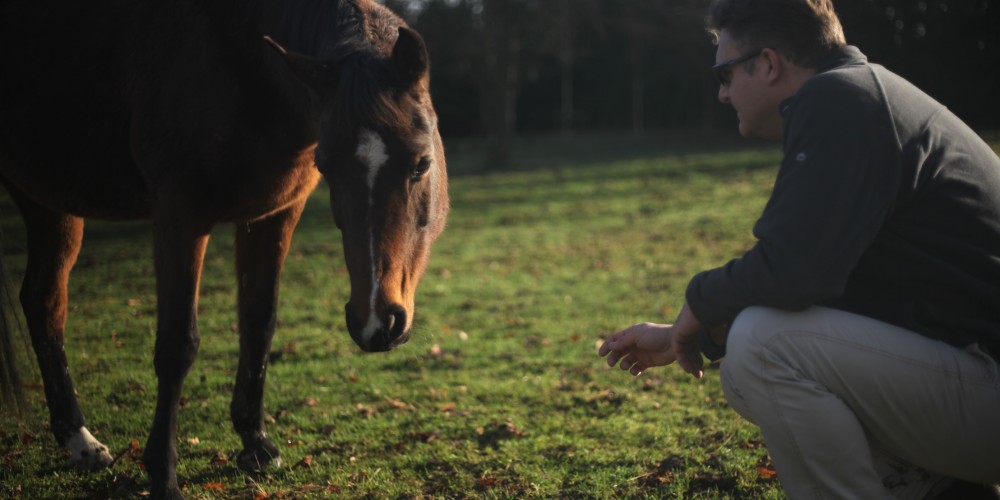
So, back to the horses. I felt in very safe hands with Kathleen Barry Ingram (Co-Creator of the EPONA approach) and Sun Tui, founder of IFEAL (International Foundation Equine Assisted Learning). The work is a blend of theory, including the science behind how our brains work (yes, ‘brains’; we have three – the head the heart and the hara or gut) and the practice of applying these. According to Kathleen and Sun Tui, it’s our ability to integrate all three brains that is key for leadership today. I am grateful to be practiced in this thinking and work through my day-to-day leadership facilitation and consultancy, but I was intrigued to see how this applied when working with the herd.
For many leaders the challenges of today’s business world – strategizing, managing complexity and the continual overload of information – means we live in our heads most of the time. And just occasionally we get to use our hearts when dealing with more human-centered situations. What we tend to do under pressure is either move into our heads, using data, or swing into a more emotional response, using our hearts.
What this work shows us is how to connect the ‘three brains’ of the head, heart and hara (the gut) to remain connected and awaken that deeper sense of knowing that manifests in ‘right thought, right action.’
Working to integrate these three is of course pretty tricky, particularly when you haven’t done it before. The missing piece in enabling us to do this effectively is, I found out, the horse.
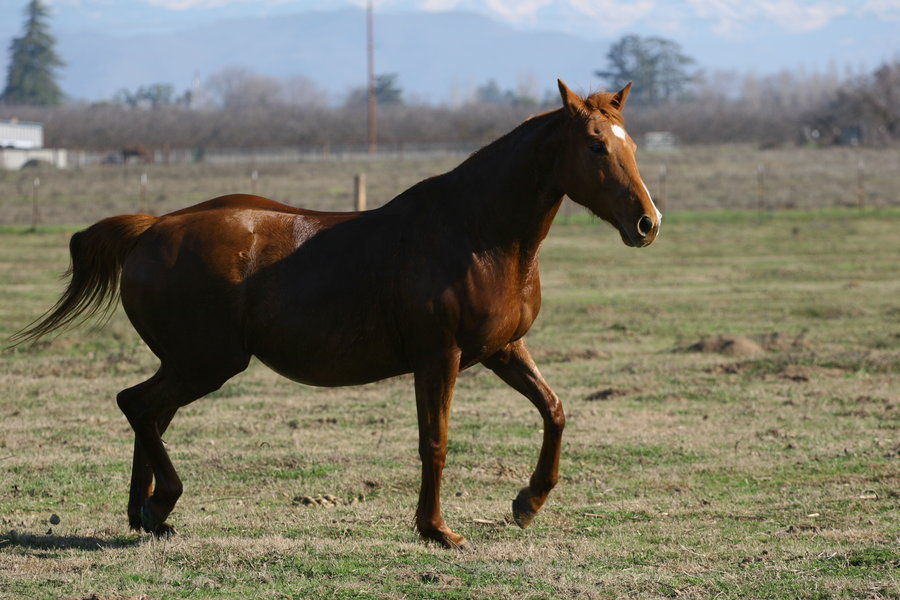
Horses have the ability to mirror our presence and offer immediate feedback. What often happens in tough situations is our relationship with our self and with others is lost or put aside when a goal, difficult decision or time constraint is present. What we learn from the horse is how to remain grounded in relationship. Maintaining connection whilst manifesting our goals and intentions involves our heart, intention from our brain, and pressure (or direction) from the belly or power center of our bodies. When one is predominant (or where balance is lost) the horse will often stand stock-still or be overcome with confusion. Basically that means we are ‘really not getting through’ in the way we need to.
It took time to get used to this type of practice, to be aware when one is switching into the rational mind alone and of the disconnection that is so easy to fall back into.
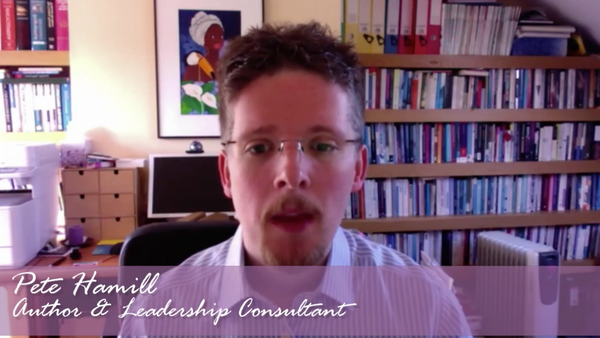
As Pete Hamill writes in his book Embodied Leadership: “These types of practices enable us to live more fully in our body, rather than a short distance from them and to experience that connection to emotions, purpose and our shared humanity – through this lies the path of leadership and mastery.”
I witnessed and experienced frustration, vulnerability, empowerment, inspiration, connection, reflection and stillness during those three days. The moment when you really connect with a horse, using the three brains, you feel the difference – and it fills you with an incredible sense of deep knowing. It shows you what is possible in human relationships when we are fully present and use our full capacity. The difference this could make to how we lead, connect and engage with others is profound and truly being in relationship to self and others is an incredible feeling – it’s like ‘coming home’.
Join Pete Hamill (Author of Embodied Leadership) for a morning workshop in London on Friday 27 Feb 2015.
 |
Where the Learning Happens
January 30, 2014 by Kathleen
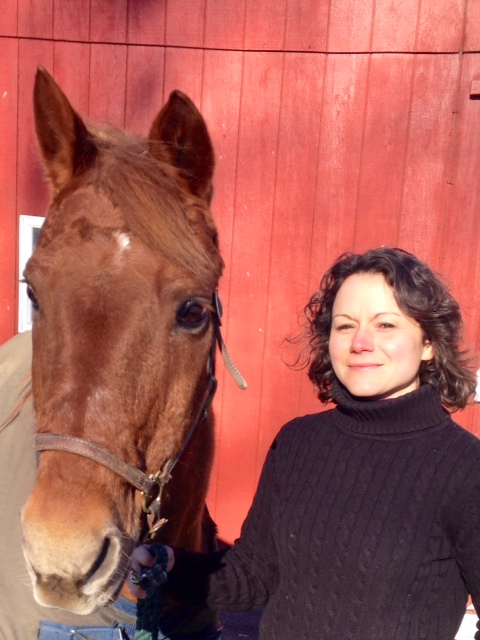 Corey DeMala is my mentorship student who lives and works in New York State. She is an accomplished equestrian and horse trainer. She is also a licensed mental health counselor and runs a successful EFL practice working with young people, adults, and couples (www.CoreyDemala.com). Corey says that her natural ability to relate to horses began as early as age 7. She would find herself in the barn with the horses in the middle of a snow storm to be with them so she wouldn’t get stuck in the house.She got her “dream job” as a horse trainer but soon learned this was not for her because the relationship with the horse was missing.
Just Breathe
September 7, 2013 by Kathleen
~ John Welwood.
I have always resonated with John Welwood’s words and the simple wisdom represented in his books and essays. As I was reading these words I recalled a session I had many years ago with a client. She had traveled far to join me and the horses at Epona for a 4 day intensive. As an accomplished equestrian and a successful psychologist she had experience and a room full of knowledge. Like many others who are drawn to this work with horses, she was seeking the implicit knowing that comes only from direct experience. (see Implicit Knowing versus Explicit Knowledge).
 She engaged in a variety of equine experiences both on the ground and mounted on the horse. I had a body worker come in for a massage and we practiced daily the Spring Forest form of QiGong. Her busy life with a husband, a child, and a full psychotherapy practice was put on hold. She fell in love with Noche, our wise older Mustang. I believe Noche helped her “listen to the wind singing in her veins”. I asked her towards the end of our time together what she wanted to take away from her experience. She replied simply and with an open heart, “Noche told me all I needed to do was Breathe.”
I was touched by this simple statement. It is a constant reminder for me to remember that “pure consciousness” only happens when we drop all of our doing, our roles and live fully in the moment between each breath.
The following story is told by one of my students about her experience with a client and a horse called JR. As she told me about this experience I found myself with tears rolling down my face and was deeply moved by JR’s wisdom and her courage to trust her heart, her intuition and his guidance. She said this was an example of what is possible when we allow the horses to do their work.
In the Company of Horses:
J.R. is a 14 year old registered Paint gelding, retired from mounted shooting competition. A gentle giant weighing between 1400 and 1500 pounds, this sweet soul is always honest and present for any client who wishes to learn more about life.
 With safety in the forefront, I asked David if I could be part of his team as a buffer between him and J.R.This would be new for J.R.; being led by a person in a wheelchair. I wanted David to have this experience, but it would have to be safe for him to do so. Again, J.R. was given plenty of time to acclimate to the wheel chair along with the sound of the wheels going through the sand. We started out very slow. We created our grouping with J.R. on a lunge line, then myself, and finally David holding the end of the line. As I monitored J.R.’s response, I noticed his head lower; his neck was soft, and his eyes kind and gentle. There were a total of 4 obstacles. As we walked the perimeter of the round pen, past obstacle number 2, J.R. seemed to turn his nose into my chest ever so softly and I let go of the rope, still maintaining my spot in the group.
Though this story is about the connection between J.R. and David, everyone there was touched by this sentient being. I feel so honored to witness these acts of courage. As I learned early on in my journey; miracles happen when in the company of horses.
Holding the Sacred Space
August 21, 2013 by Kathleen
Recently, I wrote about my experience with Maude and Hannah this spring in “Hannah’s Gift.” Please read Maude’s words about the event from her perspective as facilitator and Hannah as her co-facilitator. This is a great example of what I have termed “Relationship in Motion.”
So many times facilitators of Equine Facilitated Learning resort to their horsemanship techniques and patterns when doing active round pen work or giving the client an opportunity for a mounted session with the horse. I hope that the following discourse gives you a sample of the possibilities of a “simple” riding session. What is happening with the horse within a session? With…in the sacred space of possibility?
Within the Sacred Space:
 For me there is a palpable sense that we are in this together… I am aware that Hannah is observing me, taking in what I am thinking.. doing… she is “tracking” with me. And I am aware that Hannah is aware …. that I am aware of her… she knows I am watching her, taking in where she is, what she is doing and conveying to me. This is where we begin….we are ready.
Kathleen is ready to ride. I check in with Hannah, ask her silently … “Are you good with this?” “Yes,” she replies. “I am fine.” I am holding the reins underneath Hannah’s jaw, as a safety check just in case she decides to move as Kathleen gets on. My other hand is gently against Kathleen. I am “feeling” her while at the same time providing physical support. I sense Kathleen gathering herself up to step up into the stirrup. Hannah is very intent on Kathleen; very still.
All of a sudden Kathleen stops and says “Wait a minute”… “I am feeling dizzy here”… we feel it too; we pause waiting. Kathleen is quick; she lets me know that she just had a sensation of falling down the long flight of stairs; that she needs to take a minute to process this. I check in with myself – my body – what do I sense about this? Is Kathleen okay proceeding with what she is doing? Yes, Kathleen is fine. She feels present, grounded…. Busy. I check in with Hannah. Hannah is aware; connected to what is happening. She is waiting. Okay, I wait too.
Then Kathleen takes a deep breath and turns her attention to me and explains that she wants to take a moment to tell me about what just happened. She seems alert and energized. I acknowledge this and say “okay,” and “breathe.” Hannah is listening to us; she licks and chews (When a horse licks and chews it is a sign that they are listening and hearing a “truth”). Kathleen relays her experience and then is done, ready once again to ride. We re-do the mounting sequence. Kathleen is monitoring herself for a re-play of the falling sensation. Nothing comes up so she gets on Hannah.
Once up she seems to have an unsteady sensation; I pause. Hannah is watching Kathleen; right there with her. Then Kathleen is back again, paying attention to her comfort and lack thereof in the saddle. We adjust the stirrups; I lead Hannah for a few steps; Kathleen seems tentative and uncomfortable. I decide to work with her on her body comfort with the length of the stirrups; adjusting equally, unequally, stretching, feeling in certain parts of her hip, thigh. Her knee is paining her, so I take her leg completely out of the stirrup. I sense this is concerning her; I pause letting her feel her leg stretching pulling down from her hip. That is better she says. I gently bring her foot back to the stirrup. How does that feel now? “Good,” she says. “The pain is gone.” We talk about body comfort in position versus form as the objective. How important comfort is. Why I like dressage saddles; because I can feel the horse better. I feel more secure the more I can feel.
Kathleen is ready to walk on. All this time Hannah is listening to us. What are we doing? What is next? And I am listening to her; we are together in this sacred bubble. I show Kathleen how to hold the reins along with the grab strap and explain how this gives her something to hold onto if she needs. Hannah sees that now…we are ready to move? We walk off very slowly. I have to hold Hannah close to me. She is not used to taking such small slow steps. I am watching Kathleen. I feel her breathe; loosen. Okay, she is feeling better. “Okay,” she says. “Yep I’m fine, keep going.”
I am leading Hannah slowly in circles, Kathleen is relaxing down more into her seat and the saddle, so I mix it up a bit; travel in figure eights then change direction. This can feel so different from going in a straight line; changes in direction; one side weighted differently from the other; unbalance, shifting, rebalance. I sense this is making an impression on Kathleen. We continue slowly in silence. I keep watch constantly; Kathleen, then Hannah. What are they telling me?
Hannah is with us, just walking. Then she jumps a little sideways. She looks at me as she jumps… seems like just a simple reaction, perhaps to something she sees, hears, smells in the trees up on the hill above us? Not sure. I see Kathleen react, startled with the “jump”, she looks to me. I feel her inquiry, her emotion, where she is in her body. I sense Kathleen’s arousal level go up…come down a little…. and stabilize. I look at Hannah, this was just a blip. She is done and back to walking. So I keep walking. Kathleen is still looking to me. I look at her to acknowledge her; so she sees that I see; that this is okay. But I do not speak. Kathleen’s arousal level comes back down and we continue for a while longer.
Then there is a sense that this has been enough. I ask Kathleen how she is doing, if she feels like we can end. We agree we are feeling complete; that “just walking” around the arena is enough for today.
Hannah is calm…I sense she is ready to end. This has required her active involvement and consistent attention. We go back to the bale of straw and she stands perfectly still while Kathleen dismounts. We end here… Kathleen is going to journal. All is good.
Hannah’s Gift
June 28, 2013 by Kathleen
“To know our soul apart from our ego is the first step toward accomplishing the supreme deliverance”
Have you ever found yourself in a place when your body knew something that was not available to your conscious mind?
 Beauchamp at her ranch in Sacramento, California, hanging out with her horses and looking for inspiration and guidance for our workshop in September (more information below) when just that happened to me.
As I lifted my leg over the saddle to get seated on Hannah I immediately felt the entire memory of the fall down the stairs which resulted in many injuries, trauma and the right ankle broken in a few places. Both Maude and I, being good facilitators, knew that I needed to step off the horse and to process this memory. It is important to know that I did not go into this experience with a goal or a conscious desire to recreate the experience of falling. However, I know from my experience and from watching and facilitating others that the body always remembers and holds that memory.
 We took the time needed, I shed a few tears and talked about the experience and when we both felt I was ready, I got back up on Hannah. Maude was leading Hannah and I was there to enjoy the ride and to allow my body to experience the guidance and safety that both of them were giving me. If my breathing was even a little bit unsteady we would stop and wait for me to come back to a place of homeostasis and relaxation. I could feel my legs, my bottom and my whole body in sync with Hannah as Maude led us around the arena.
There are a few very important points I would like to stress about this experience for me that might also be helpful for others:
1. My body and my spirit were ready to process and heal the trauma from the fall. I did not set out to re-experience it and have it healed and released. It was released and healed because it was time.
2. You must feel safe and protected when you are processing any trauma and know you are in capable hands.
3. Your body and your mind have an opportunity through limbic connection to experience limbic revision. (for more on that, listen to my interview with Jennifer Oikle, “Limbic Lessons“)
In this work we teach about the difference between an outside fear and threat of physical, spiritual or emotional harm and the inside “fear” of vulnerability. My body did not know the difference and was at first responding to the situation as if it was a fearful place and one to run from or avoid. It takes some time to differentiate between these two types of fear. Both fear and vulnerability feel the same in the body and the body responds as if there is an outside threat.
I felt it important to share this experience with my readers because even though I am a teacher in this field of equine experiential learning and psychotherapy I was not consciously aware of the memory my body was holding. I have done a lot of healing, body work and processing around the experience but my body, having a “mind” of its own knew that further release and rejuvenation was needed. I do feel that the process with Maude and Hannah allowed for a complete release and a baby step to riding on the trails again. I am forever grateful to both of these “wise mares” for their love and guidance.
For more information on body memory and trauma look at Peter Levine’s work; “Waking the Tiger” Healing Trauma and the “The Body Remembers” The Psychophysiology of Trauma and Trauma Treatment by Babette Rothschild. These books have been useful for those of us working with trauma and the new neuroscience of emotions has given us even more evidence about the body’s innate wisdom.
The Power of Relationships
March 10, 2013 by Kathleen
| Mentorship in Equine Facilitated Learning |
|
When people ask me what is different about your approach and teaching style, I respond, “I am interested and very excited about what I call the ‘psychological/scientific/spiritual underpinnings’ of an equine facilitated learning experience.” I have found over my 15 years of teaching this work thatthe best facilitators really know and understand themselves, and are willing to identify and be consciously aware of their internal emotional, psychologically and physiological processes.
Toni is about ½ way through her mentorship program, which means she is practicing with volunteer clients. This essential practice is monitored and recorded by the student and discussed pre and post session with me. To follow are Toni’s own words about her third practice session with a client. Note her references to “arousal- window of tolerance” (Mindsight: The NewScience of Personal Transformation, Daniel J. Siegel, M.D); “feeling felt” (Siegel) and “limbic connection” (material and references from A General Theory of Love, Thomas Lewis, MD, Fari Amini, MD, Richard Lannon, MD). These notable researchers have given us valuable information about the importance of relationship in the healing process. Toni’s Session with her Horse Stocky and Client “During my pre-session body awareness and observation process, I was surprised to notice how relaxed and confident I felt going into my 3rd EFL practice session. I observed mild excitement about what may transpire with my courageous client and equine friends. My bodily functions felt rhythmic, comfortable and relaxed. It was a beautiful day, and I believe the warm weather contributed to the relaxation and peace I was experiencing. I was thrilled to get outside the barn and spend the entire session outdoors amongst the healing presence of nature, and for my client to experience the possibility of more movement with the horses. My energy felt grounded and positive, and I was keen to share this energetic momentum. I was also aware that this positive arousal may inappropriately affect the creation of a sacred space. I was struck by the self-assuredness I was experiencing in relation to the potential usefulness or outcome of the session, as I was confident the horses would offer my client whatever she needed that day. I found it fascinating to monitor my inner experience so closely, and was amazed by the rich information my body was offering me as I went through this pre-session personal evaluation.
My client was notably relaxed when she arrived for her session, presenting as relaxed, open and engaged. When I inquired into my client’s arousal level upon commencement of the session, she identified herself as being at a 1 or 2 which closely matched my own body sense and observations of her. This again affirmed the importance of acknowledging my body as a sensing device and as absolutely integral to the process of change facilitation. My client’s arousal stayed at a 1 and 2 for most of the session, with the exception of a short period during the Leading Exercise where Stocky refused to move or respond to any of her requests. During this moment of discomfort, I felt my own arousal begin to intensify as I noticed her increasing agitation with his lack of compliance. I found myself struggling with my own need to rescue, and the compulsion to take over and “show her what to do” to engage my horse and offer effective leadership.
As in the past, I used this rescue tendency as a learning opportunity to focus on my own breathing and self-regulation, offering myself as an energetic anchor by opening my core and focusing on the manifestation of limbic connectivity. When I noticed my client’s arousal increasing, I attempted to bring it to her attention by asking her what her intensity level was at that particular moment, and whether she noticed any changes in her body. Through this gentle encouragement of an internal assessment process, she was able to come to her own understanding that a shift had occurred as she identified herself at a 4 or 5. In fact, her ability to access this information and share it with me had improved exponentially from the first session. As a result, I do believe she is starting to become more in touch with her own bodily sensations and the rich information easily available to her. Personal awareness is integral in an EFL session as it is a relational process involving a sentient being that is perceptive and responsive to energetic changes. Connectivity is directly impacted by arousal, so it is of vital importance we stay attuned to moment-by-moment shift. It is also important so that the client’s “window of tolerance” (Siegel) can be gauged throughout the experience, and addressed in a gentle, ethical and safe manner. Without understanding arousal, the risk of taking someone too far too fast is increased which can be detrimental to our client’s well being. Throughout this session, there were many moments of intense connection and disconnection between my client and my equine co-facilitator. It amazed me to see how “in the moment” these shifts would take place, fleeting and changing sometimes within a span of seconds. The horse’s ability to mirror the client’s presence and offer immediate feedback will never cease to amaze me.
As always, I was offered a window into my client’s internal workings as she went through the leading exercises, which provided valuable material to work through during the session. My client seamlessly connected her experiential struggles with Stocky to her life “out there”, clearly indicating that she lacks integration between her 3 energy centers and that confidence, clear communication, and intention are extremely challenging.
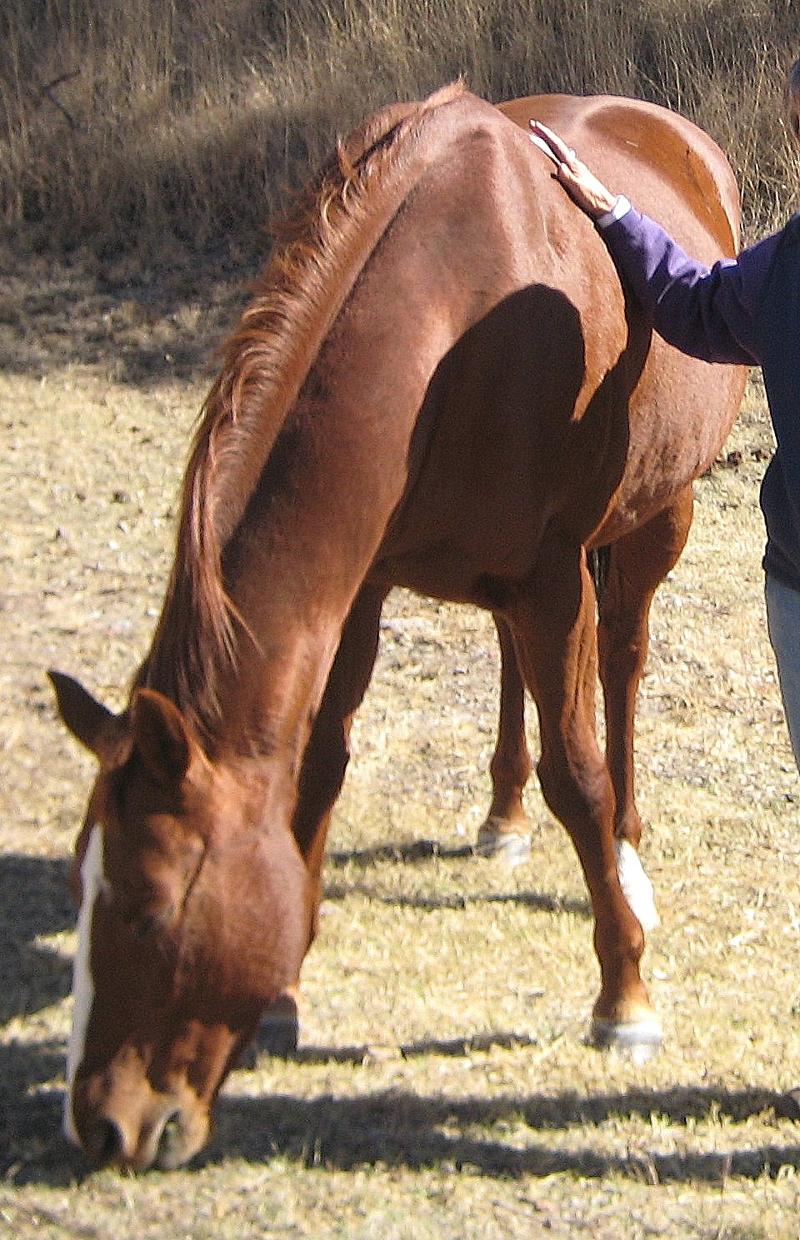 Experiencing the dramatic shift in Stocky when she (my client) managed to align all aspects of herself was quite profound and emotional. She couldn’t believe what it “felt like” to experience this type of leadership integration, and it was quite fascinating to watch her physically transform as the session progressed. Her eyes lit up, shoulders went back, and she started walking with a new sense of purpose and belief. Stocky continued to respond to my client’s new found leadership, offering her his trust and following whatever request she made. I encouraged her to take this learning and look for opportunities in her “real life” to lead in an integrative manner, and to reflect on how well Stocky responded to her when she was able to do so. Experiencing the dramatic shift in Stocky when she (my client) managed to align all aspects of herself was quite profound and emotional. She couldn’t believe what it “felt like” to experience this type of leadership integration, and it was quite fascinating to watch her physically transform as the session progressed. Her eyes lit up, shoulders went back, and she started walking with a new sense of purpose and belief. Stocky continued to respond to my client’s new found leadership, offering her his trust and following whatever request she made. I encouraged her to take this learning and look for opportunities in her “real life” to lead in an integrative manner, and to reflect on how well Stocky responded to her when she was able to do so.During this session, the limbic resonance was immediate between these two, with my client finally opening herself to Stocky in a way she hadn’t in the past. She was drawn to him, and the unspoken language between them was beautiful to observe. As always, I struggled with containing my own arousal during the observation of this connectivity. Instead, however, I went inside myself, breathed deeply into my own energy centers, and did my best to offer myself once again as an energetic anchor to the sacred and healing moment occurring. The importance of this ability to “step back” and transcend ego-driven impulses continues to amaze me.
Once I have allowed these highly charged emotions to pass, I am blown away by what occurs without my outside interference. The saying “it’s not about me” takes on a whole new level of significance, and I am once again reminded of the healing nature of relationships.
As always, I was touched by the beauty, grace, intelligence, receptivity, love, courage and honesty offered by my amazing equine co-facilitators. A common and often mundane therapeutic or self-help topic of “what constitutes good leadership” turned into a unique, experientially rich learning opportunity that engaged and captivated us both. I was struck by the natural unfolding of key elements important to this area of personal / professional development, and by the fact that I didn’t have to “talk” or explicitly “teach” any of it. The learning was clearly in the doing, impacting my client on a fundamental level that she can translate into all her relationships.
This mentorship experience has been incredibly fulfilling, enlightening and transformative for me on numerous levels. The learning and development offered through the readings, consultations with Kathleen and the experiential sessions transcend words. I continue to be profoundly impacted by the connection and healing offered by these beautiful beings, and the overwhelming ‘power of relationships’.” Thank you Toni for this excellent description of the experience between you, your horse and the client! Toni can be reached via email at: vatonia@gmail.com.
I suggested that my student put her “heart in her feet”. It was one of those moments when you come up with a comment that doesn’t sound logical but worked! As soon as my student changed her focus, her horse joined up with me and we walked around the arena together at his pace. A herd of cows distracted him for a short time but I took the pause and waited for him. The look and the pleasure on my student’s face when we came back to her were priceless. She learned that even good positive thoughts and feelings could affect the outcome of the client’s experience. |
 The mentorship readings and consultations thus far have significantly expanded my understanding of this integrative process. I now have enhanced awareness of the valuable information my body holds, and its vital importance to the relationship and change process. It is essential we pay attention to our own arousal so we are able to understand the energy/thoughts/ feelings we are bringing to the relational experience about to transpire. It is essential we are able to separate our own history, preconceptions, emotional triggers, projections, counter-transference concerns and present moment bodily responses from those of our clients. A sacred space offering the client the experience of “feeling felt” (a term coined by Daniel Siegel) can be created only if we notice and appropriately nurture these fundamental aspects of ourselves.
September 7 – 9, 2012: Earthwalk, Shapeshifting for the 21st Century, Gaston, OR
July 16, 2012 by Kathleen
Featuring Kathleen Barry Ingram, Co-founder of the Epona Approach™ & Holli Lyons, Advanced Instructor
Spend 3 days surrounded by trees, nature, horses and the silence.
Some cultures believe every species was given Original Instructions; how to be what they are, not something else. Original Instructions on what it is to be a horse, rock, or plant. Horses know how to be a horse; they don’t try to be a rock or a plant.
Many human beings have forgotten what it is they are here to do, how to walk as a human. They have forgotten their Original Instructions.
Our time on Mother Earth is our Earthwalk™; our time to walk the human path, to remember what it is to be human and live a GOOD human story.
It was once common thought that we were our past and our future was predetermined by the experiences of that past. We now understand through the Science of Neuroplasticity that we can change, direct and intentionally create our future. We are no longer prisoners of our past.
Using Merging Epona™ basic and advanced material with nature based traditional wisdom, creative/somatic expression, the latest in neuroscience and the most ancient of animal behavior, Kathleen, Holli and the horses facilitate an opportunity for you to understand, experience, explore and integrate universal wisdom into your everyday life.
Horses facilitate awareness, change, growth, intentional creation, love, play and joy. Shapeshift Walk a Good Earthwalk™. Remember your Original Instructions.
9:30 a.m. – 5:00 p.m. Friday
10:00 a.m. – 5 p.m. Saturday & Sunday
Cost: $ 695.00 includes lunch, snacks & all materials
For information or to register, contact Holli Lyons 503-662-3213 or holliswarmblood@aol.com.
Workshop held at Lyons Gait, Gaston, Oregon.
September 17-21, 2012: Equine Assisted Qualifications: Facilitator Training Programme with Kathleen Ingram, United Kingdom
July 16, 2012 by Kathleen
IFEAL Qualifications and Facilitator Training Pathway
The IFEAL Qualifications Training Programme offers a new, cutting edge and exciting approach, challenging us all as aspiring educators and practitioners in this field to verify and ground our work in solid research and years of case experience.
 The IFEAL training programmes are based upon ethical Authentic Horsemanship/Horse Management specific to horses who take part in Equine Facilitated Learning work. This is an important aspect because the horses are regarded as part of the Faculty at IFEAL.
The methodology of IFEAL incorporating Epona Approach™ ensures Horses and Humans work in non-coercive environments. The work is consensual in every aspect and, as such, the emotional, mental and welfare needs of the horse are fully taken into account.
If you have completed Step 1: Basic Training and Step 2: Advanced Training then you are ready for Step 3: Specialisms.
Step 3 Specialisms: IFEAL Specialist Training (FTP 03)
Training to continually innovate and adapt the horse-work in depth with your own professional background, such as:
• Business (FTP 03.1) e.g. coaching, mentoring, staff development
• Psychotherapy (FTP 03.2) e.g. using specific modalities
• Spirituality (FTP 03.3) e.g. spiritual growth and practice
• Healing Practices (FTP 03.4) e.g. bodywork, alternative approaches
• Transition Trauma (FTP 03.5) e.g. military and other specific trauma arenas
Step 3: Specialism is a pre-requisite for Step 4: IFEAL Master Facilitator and Programme Training.
For more information or to register, visit: www.IFEAL.me
September 22 – October 2, 2012: Connecting the Pieces: Private Sessions with Kathleen Barry Ingram and Sun Tui: United Kingdom
July 16, 2012 by Kathleen
The researched evidence is that in order for any therapeutic technique to be effective, it is essential that the person is fully present, empathetic and congruent.Private day/days Intensives affords the opportunity for an individual (or partnership; either personal relationship or professional) to deepen awareness of personal issues, core feelings and areas of bodily tension that inhibit the ability to reach your fullest true potential.
 Elemental horse related activities, that could include a sweat lodge set with in the IFEAL herd’s woodland environment and swimming, are designed to explore and integrate an expansive, yet grounded mind set, capable of endless compassion, innovation, energetic adaptability and creativity.Our work will include experiencing the spiritual and scientific biology of emotions to integrate them with the Mind and Body. Doing so elicits Working Relationship in all areas of personal and professional life. Elemental horse related activities, that could include a sweat lodge set with in the IFEAL herd’s woodland environment and swimming, are designed to explore and integrate an expansive, yet grounded mind set, capable of endless compassion, innovation, energetic adaptability and creativity.Our work will include experiencing the spiritual and scientific biology of emotions to integrate them with the Mind and Body. Doing so elicits Working Relationship in all areas of personal and professional life.
Kathleen Barry Ingram, co-founder of The Epona Approach™ is a Tucson-based life coach, consultant, lecturer and educator specializing in Equine Facilitated Experiential Learning. Sun Tui is the founder and director of IFEAL and is an Advanced Epona Approach Instructor. She teaches Horse Way Tai Chi and Integral Body Mind Therapy. To book a private session: www.IFEAL.me |
Mustangs
July 16, 2012 by Kathleen
Mustang : The Saga of the Wild Horse in the American West By Deanne Stillman[1]
Deanne’s excellent book is heralded by numerous authors and environmentalists as a tribute to the land and the horse. This excerpt from the introduction will make you want to learn more about the Mustang and the many blessings of the horse/human bond. Many of us practicing Equine Facilitated Learning speak about this partnership, and I believe that Deanne speaks eloquently for the horse by exploring our relationships, our origins, and the compelling need to save the horses and ourselves.
From Introduction:
 |
| Deanne Stillman and Bugz, Photo by Betty Lee Kelly |
How and when did the moment of partnership first occur? No one knows for sure, and there is much speculation on this subject. But however it happened, it’s clearthat the horses’ ability to provide flight was universally desired, and nowhere is this desire more pronounced, more extreme, than in America, where escape and the chance to start over is not a pipe dream but a birthright. We may not think of ourselves as part of a horse culture, like the nomads of Mongolia, for instance, but in our own way, we are; we worship cowboys and we’re jacked on freedom and we love moving fast through wide-open space, preferably on a cactus-lines highway in our most iconic car, the Mustang, whose grille features a galloping pony. Yet as we ply the road, many of us do not realize that the real thing is fighting for its life on the rocky playas just over yonder, staking our the dream, being wild and free for the rest of us…
As you follow the tracks of the wild horse, perhaps you’ll agree that it deserves a safe haven in the country it helped to build, deserves the protections it once had and were only recently unraveled; perhaps you may have a greater understanding of the forces that are contriving to wipe out our loyal partner, the one in whose hoof sparks this country was born. We may be fighting wars around the world, but in the West, to paraphrase the great environmental writer Bernard DeVoto[2], we are at war with ourselves. To me, there is no greater snapshot of that war than what we have done and continue to do to the wild horse. As it goes, so goes a piece of America, and one of these days, bereft of heritage, we may all find ourselves moving on down the road.”
~Deanne Stillman
So, it is not only the Mustang and wild horses in America whose freedom is endangered, but all of us who try to restrain and limit others and in the process also limit ourselves. The horses’ ability to be in the present moment, to serve as our loyal friends, and to run like the wind reminds us of our own authenticity while they hold the sacred space of possibility for us to reconnect with our hearts and souls.
[1] Stillman, Deanne. Mustang: Saga of the wild horse in the American West. New York, NY: Hough Miffin Books, 2008
[2] De Voto, Bernard. The Western Paradox. New Haven: Yale University Press, 2001
September 25-27, 2012: The Zone of Intuitive Knowing; United Kingdom
May 18, 2012 by Kathleen
 Exploring the Scientific, Psychological and Esoteric Dimensions of the IFEAL Approach with Kathleen Ingram and Sun Tui
The Zone of Intuitive Knowing is a radical program for people interested in the neural science, subtle energetic and physiological connections between all of life. It is thought that all beings exist as a unity, interdependent in relationship with all in the invisible web of the quantum field. Horses, as consummate teachers, can show us how to re-discover, connect and develop our ‘knowing’ selves. The Zone of Intuitive Knowing comes directly from aligning the ‘brain in the gut’ with the ‘brain in the heart’ and the Mind.
Your biography becomes your biology.
This program includes experiential opportunities with the horses that engage our innate abilities to use the body as a tool for self-knowledge and perception for health and wellbeing.
Most psychologists treat the mind as disembodied, a phenomenon with little or no connection to the physical body. Conversely physicians treat the body with no regard to the mind or the emotions. But the body and mind are not separate and we cannot treat one without the other. Research has shown that the body can and must be healed through the mind and that the mind can and must be healed through the body.
Neuroscientist, Candace B Pert, Ph.D
Direct, spontaneous healing happens easily when we understand our pain and illness from the perspective of The Present. The focus is primarily on what the feelings or body sensations are in the moment, in the NOW. This way we effortlessly let go of the limiting beliefs and stories of the past and re-script new life enriching pathways to a future of other possibilities and potentials.
The Zone of Intuitive Knowing explores:
- Developing courage and confidence to choose health and well being
- Increases presence and effectiveness in life
- Collaborative relationships with sentient beings with mutual respect for accessing deeper wisdoms
- Communication and connection with clarity whilst in movement and flow of life
IFEAL Experiences take place with horses working on the ground in their natural environment. No riding is involved and no experience of horses is required.
*Follow up individual coaching sessions are available in conjunction with this workshop.
April 26-29, 2012: FEEL Certification Program, Toronto, Canada
March 13, 2012 by Kathleen
In April, I will once again be joining with Horse Spirit Connections and the students in Toronto, Canada. I teach what I call the “foundational pieces” from psychotherapy, science, and spirituality in this exciting and thorough program. Below is a short description of the program. To find out more about the program and to register contact Wendy@HorseSpiritConnections.com
Horse Spirit Connections founded the FEEL (Facilitated Equine Experiential Learning) Certification Program in 2008. FEEL is a leading-edge modality for developing human potential. Participants learn to create a horse-centered, experiential learning environment that supports personal growth. Throughout the training, prospective FEEL facilitators gain self-knowledge and acquire skills and experience to develop their own FEEL programs where horses are valued for their roles as teachers and therapists.
 This comprehensive training program is suitable for coaches, educators, facilitators, equine professionals, wellness practitioners, and other individuals who are looking for practical training and experience in developing Facilitated Equine Experiential Learning programs in the expanding field of Equine guided healing.
The FEEL Certification Program is six months in duration. It consists of sixteen days of on-site instruction spread over three sessions. Many dynamic teachers, with an incredible array of knowledge, are present to support the journey.
During the six months, there will be individual and group assignments integral to a deeper understanding and first hand experience of this new modality. In between program sessions the participants are required to practice and complete assigned horse related activities and log their experiences. A program mentor is assigned to each participant for the duration of their training.
June 5-7, 2012: A Master’s Course – The Art, The Heart, & The Science of Deep Listening through Team Coaching and Group Process: Corrales, NM
March 13, 2012 by Kathleen
A 3 day Intensive training in Group Process and Dynamics in Corrales, New Mexico with Kathleen Barry Ingram and Lisa Murrell, Susan Castaneda, and the Ranch DuBois herd.
 Lisa and Kathleen, leaders in the field of Equine Facilitated Learning, Team Coaching, Coaching and Psychotherapy, will use their expertise, combined 30+ years of experience, and the latest scientific research to teach and encourage participants in the effective use of team coaching and group process.
As a therapist, counselor, coach or personal growth teacher you understand the “double edge” power of human groups. Groups can create a transformative container for growth and self-discovery, but when groups go wrong they can destroy trust and leave participants more defensive than before. This is even more true for groups organized around EFL/EFC experiences, where the horses create moments of great transformative potential. Masterful group facilitation is critical to successful and safe Equine Facilitated Learning and Coaching.
This dynamic and intimate intensive will help you learn to masterfully facilitate the challenge of fully engaging both individuals and the group. Through dynamic teaching and learning techniques you will discover powerful ways to get out of the ‘story’ and into the heart of the matter. These tools will enable you to use the energy of the “difficult” client as a tool for monitoring the emotional safety of each group member.
 This training is for counselors, therapists, coaches, health care practitioners, and anyone currently teaching and facilitating Equine Facilitated Coaching/Learning and psychotherapy in groups. Whether you work with adults or youth, closed or open groups, or whether your scope of practice includes Psychotherapy/Learning or Coaching-this training will give you valuable information and increase your confidence and skills in facilitating group process and understanding group dynamics.
Cost: Early Bird Price $797 (Before March 30, 2012)
Price after March 30: $1297
To register: www.EquineAlchemy.com
Questions? Contact Lisa: Lisa@EquineAlchemy.com
Fast Action Bonuses (Act before March 30, 2012):
*The first 2 participants to register will receive a private coaching session with Lisa or Kathleen!
*The first 4 participants to register can bring a friend for 25% off!
***International Coaching Federation CCEU’s available
***CEU’s available
Healing Intuition Learned from Horses: Christy Allen, Lic. Ac.
March 13, 2012 by Kathleen
Christy Allen: Acupuncturist and Chinese Medical Practitioner
 Christy is a friend and colleague who I believe is the best practitioner of traditional Chinese Medicine. Her skill and gentle touch have been a part of my healing for the past 15 years. I credit Christy and other healing colleagues to my full recovery from my recent ankle surgery and full knee replacement.
One of the most frequent questions I’ve been asked over the 17 years I’ve practiced Chinese Medicine is: “How did you develop the exquisite energetic skills you have, to perceive and treat the human energy field?” Over time, I’ve realized that horses played a major role in my earliest development! By age 5, I was riding in Western-style horse shows; and between the ages of 7 and 16, horses were my constant companions. Through them, I learned how to “listen” to nonverbal communication, to sense their moods and anticipate their desires. During hours of grooming, I learned the art of palpation – and I loved to drape my body over a bareback horse, and imagine that I could merge with its horse nature… and see the world through its eyes. I also learned to watch horses move, and observe subtle changes that suggested an injury or strain might have occurred. Decades later, I would find the same skills applicable to my work with humans.
There are many different traditions and approaches in Oriental Medicine – in this respect, it is similar to the martial arts: innumerable styles and forms, all combinations of technique and artistry. As the medicine of ancient China spread across the globe, its comprehensive approach to understanding not only the mechanisms of disease, but also ways to prevent illness and enhance strength and endurance became legendary. But less well-known in the West is what I like to call the Inner Tradition of Chinese Medicine – the vital role of the spirit; the knowing of the Heart; and the roadmap to illumination that dots the human form in what we now call “acu-points.” These points have ancient names (pictograms, actually) — like “Encircling Glory,” “Spiritual Soul Gate,” “Palace of Weariness,” and “Inner Frontier Gate” – and describe states of being that can be woven into a unique treatment that touches Body, Mind and Spirit, equally.
In my role as Practitioner, I seek to generate vitality and clear perception in all of my clients – for even as they work on the mundane issues of the body, patients can simultaneously benefit from the transformational capacities of this Classical approach I practice. Healing dreams often appear, populated by symbols that relate to the 5 Elements and/or the “spirits” of the acu-points. Patients also speak about a sense of personal “authenticity” they feel re-awakening, as their Qi (vital energy) becomes stronger and more balanced. Moods and cognition typically improve; chronic health problems can be resolved; and the higher virtues of existence become actualized.
If you seek to complement the work you are doing with horses by working on your own inner journey – and feel I can help in any way — please don’t hesitate to call on me!
Many blessings!!
Christy Allen, L.Ac., Dipl.O.M.(NCCAOM) – Acupuncture & Oriental Medicine
EnerQi Health, Tucson, AZ
520-401-9796
Christy@EnerQiHealth.com
Wednesday, January 25, 2012: Coaching From the Heart a FREE Internet ‘Salon’
January 22, 2012 by Kathleen
Coaching From the Heart: A FREE Internet ‘Salon’
Wednesday, January 25, 2012 at 1:00 PM EST
Are You A Coach Who Wants to Create Transformation, then join Lisa Murrell and Kathleen Ingram on for a FREE live streaming internet “salon” called “Coaching From the Heart” on Wednesday, January 25, 2012 at 1:00 PM EST
What is coaching from the heart? A way of connecting with ourselves and our clients that is based upon relationships and recognizes the value of emotions and energy in supporting and guiding those who come to us for coaching –concepts that are inherent horse wisdom and difficult to learn in traditional coaching programs.
Equine Coaches, Simon, Tibor and Spanky will join us as we go deeply into a conversation about:
- The 5 critical elements for transformational coaching
- How the ‘Shadow Self; (those unrecognized and unaccepted aspects of ourselves) hold important wisdom for our coaching and clients.
- Why emotional and energetic agility is THE future of coaching.
- How you can take your coaching to the next level through Equine Assisted coaching!
Your first Salon? A Salon is a gathering of like-minded people under the roof of an inspiring host, held partly to amuse one another and partly to refine taste and increase the knowledge of the participants through conversation and connection.
What is Live Streaming? A very nifty piece of internet technology that will let us interact and engage live- almost like we were together in person – ala ‘salon’. (Don’t worry, if you can open a URL in your web browser, you’ll be able to participate easily and with grace.)
To register for this call visit Lisa’s site: www.EquineAlchemy.com
February 3-5, 2012: “Launching Your Coaching Journey,” A 3 day Learning Intensive with Lisa Murrell and Kathleen Barry Ingram, Albuquerque, New Mexico
January 22, 2012 by Kathleen
This experience can, and most likely will, change your life!!
Are you ready to step into your greatness and share your gifts? Do you want to wake up each day excited and full of gratitude because you are living your life with a clear purpose? Would you like to live in a like-hearted community of learning and support? Then you have arrived! “Launching your Coaching Journey” is about launching your life as you intend it to be from now on…. Coaching is not a ‘job,’ it is a way of being.
Relationship building is at the heart of coaching! The experience of working with horses requires a relationship with another being. It requires an acute awareness of boundaries -yours and theirs- as well as skill in interpreting body language. Interacting with horses requires obtaining permission to lead and demonstrating a willingness to follow. Such a relationship demands courage as well as vulnerability. Most importantly, the horse requires authentic communication. Twenty minutes in the round pen with a horse will take these powerful, insightful concepts off the page, out of your head, and anchor them into your entire being. You will also experience a tremendous boost in self-esteem and confidence from learning how to connect and establish boundaries with a thousand pound creature through a mind/body connection, presence and clarity of intent and connecting with your ‘heart’s desire’.
Virtual Classroom Work before the in-person learning intensive to prepare for our time with the horses will include:
Introduction to Coaching
-The ICF competencies and standards
-Distinctions between therapy and coaching
-Setting the coaching foundation
-Co-Creating the relationship, Part 1
On-site Equine and Experiential Components – Creating Awareness of Self and Others:
Through a series of specially designed activities with horses on the ground (no riding), you will deepen awareness of your personal challenges, core feelings and areas of bodily tension that inhibit your ability to reach your true potential.
Launching your Coaching Journey Workshop includes:
-Pre-site work
-3 day on-site learning intensives with the horses
-1 private coaching session with Lisa
-1 90 min content session with group
-1 90 min peer coaching call
This is an ICF Approved Coach Training Workshop
Cost: $2000 per person
For more information, or to register, visit: www.EquineAlchemy.com
March 19-21, 2012: The Zone of Intuitive Knowing, an Intensive with Kathleen Barry Ingram and Sun Tui, United Kingdom
January 22, 2012 by Kathleen
The Zone of Intuitive Knowing led by Kathleen Barry Ingram MA co-creator of The Epona Approach ™
Exploring the Scientific, Psychological and Spiritual Dimensions of Equine Facilitated Learning and Psychotherapy
If you are interested in the subtle energetic connections between all of life then this workshop is for you. We exist as a unity, interdependent in relationship with all in the invisible web of the quantum field. Horses, as consummate teachers, can show us how to re-discover, connect and develop our “knowing” selves. The Zone of Intuitive “Knowing” comes directly from the ‘brain in the gut’ and the ‘brain in the heart’. This workshop includes experiential exercises with the horses that engage our innate abilities to use these organs of perception. We can choose to enter the Zone of Intuitive “Knowing” through direction from these powerful centers of intelligence in concert with the intelligence centered in the brain. When fully grounded we are able to extend our self-awareness into all aspects of daily life and live authentically each moment with tangible success.
Business and life coaches, counselors, psychotherapists, healing therapists (any discipline), teachers, business managers, trainers and consultants, all horse professionals or anyone interested in human growth and development will find this workshop helpful. This is a no- riding workshop.
This workshop can be used as a qualifying workshop for IFEAL Facilitator Training
Cost: £1,450.00
Contact Sun Tui: SunTui@me.com
For more information or to book this intensive: www.IFEAL.me
April 2- 5, 2012: Connecting the Pieces, Private Sessions with Kathleen Barry Ingram and Sun Tui, United Kingdom or Cypress
January 22, 2012 by Kathleen
Connecting the Pieces, Private Sessions with Kathleen Barry Ingram and Sun Tui
The researched evidence is that in order for any therapeutic technique to be effective, it is essential that the person is fully present, empathetic and congruent.
These private day/days Intensives affords the opportunity for an individual (or partnership – either personal relationship or professional) to deepen awareness of personal issues, core feelings and areas of bodily tension that inhibit the ability to reach your fullest true potential. Elemental horse related activities, that could include swimming or a sweat lodge set with in the IFEAL herd’s woodland environment, are designed to explore and integrate an expansive yet grounded mind set, capable of endless compassion, innovation, energetic adaptability and creativity. Our work will include experiencing the spiritual and scientific biology of emotions to integrate them with the Mind and Body.
Each session is custom tailored to meet individual’s needs, lasts 3 hours or more, begins with Tai Chi with the Herd.
A biodynamic organic lunch and nutritious snacks tailored and served to your taste are provided.
Kathleen Barry Ingram, co-founder of The Epona Approach™ is a Tucson-based life coach, consultant, lecturer and educator specializing in Equine Facilitated Experiential Learning
Sun Tui is the founder and director of IFEAL and is an Advanced Epona Approach Instructor. She teaches Horse Way Tai Chi and Integral Body Mind Therapy.
Special Note: These intensive sessions are also available at Sun Tui’s Olympus Mountain retreat home in Cypress. The home is a beautiful 11th century cottage, with mountain views over the 11th Century Monastery and Monagri village. The cottage is a pleasurable scenic 30 minute drive to either glorious Mediterranean beaches or breathtaking views from the top of Mount Olympus. On-site accommodation available.
Contact Sun Tui: SunTui@me.com
For more information or to book a private session: www.IFEAL.me
April 12, 2012: The Power of Horses: An Introduction to the Epona Approach ™ with Kathleen Ingram, Dusseldorf, Germany
January 22, 2012 by Kathleen
The Power of Horses: An Introduction to the Epona Approach ™ with Kathleen Ingram, Co-founder of the Approach.
 A full day of learning, horse experience, and the basics behind the Epona Approach ™. This is not a method of training but an approach to being in integrity with the horse and the client.
Cost: 180€ with snacks and a vegetarian lunch.
This workshop will be held in English – German translation possible if required.
Please contact Eva Balzer, Stockweg 143, 45481 Muelheim an der Ruhr, Germany
www.Zentaura.de
Email: kontakt@evabalzer.de
Mobile phone: +49 (0)172-2320836
April 14-15, 2012: Connecting with the Heart – Yours and the Horse’s, Dusseldorf, Germany
January 22, 2012 by Kathleen
Grace in Presence and Flow in Movement.
 This 2 day workshop is an advanced workshop for those already familiar with the Epona Approach™ which is not a method of training or working the horse. Kathleen Ingram, as the co-creator of the Epona Approach™ with Linda Kohanov (author of the “Tao of Equus”), along with Eva and her magnificent herd will encourage the participants to follow their hearts in a respectful relationship. This workshop will help participants to maintain connection with respect and afford opportunities to take this into movement with the horse. Each individual’s intuitive gifts and the horses true essence is honored and encouraged.
Daniel Siegel, author of “Mindsight“, uses the description of this honoring of self with others and calls this “feeling felt”. In order for this to take place both the horse and the person must feel and experience the soul and essence of each other. As facilitators, we hope to help others to be open to their unique gifts and challenges. We will assist them in this integration for following the original “blueprint of their souls”. To do this the person must be present to what is happening and look for collaboration in stillness and movement, essentially what Kathleen has called the “Yin and Yang of It”
Cost: 395€ with snacks and Vegetarian lunches.
This workshop will be held in English – German translation possible if required.
Please contact Eva Balzer, Stockweg 143, 45481 Muelheim an der Ruhr, Germany
Email: kontakt@evabalzer.de
Mobile phone: +49 (0)172-2320836
Relationship in Motion (RIM)
December 11, 2011 by Kathleen
 2011 has sure been an eventful year with many challenges and opportunities for all of us. If you are like me, you are ready to see what 2012 is all about! I see this as a time of expanded conscious awareness for all of us. Certainly, my work with the horses all over the world supports this. Recently I was asked, “What do you see and feel is the common denominator with horses and people in your travels?” As always, my answer was “horses are helping us to wake up.”
My colleagues and I have been working on a concept which we call Relationship in Motion or RIM. Over the years in my work in Equine Facilitated Learning, as well as work with families and corporations, I have noticed that much of a relationship is lost or put aside when a goal, deadline, or time constraint is present. In EFL I notice that people may love connecting with the horses on the ground through grooming, reflective round pen work (one in which there is no goal but to be in relationship), or just standing and being with the herd in the field.
However, because we are human, and many times goal oriented and constrained by time limits, I see people dropping the feeling of connection to get “the job done.” RIM is a process we are developing that assists the person to be in relationship- or limbic connection– with the horse and get motion or movement with collaboration. This may seem simple but those of us working with horses, children, spouses or employees know this is not always the case. What parent hasn’t temporarily “lost it” when asking their child for the 100th time to clean up their room? When you are going to get your horse for an activity with a client, do you remember to tell them what you would like?
We know that maintaining a limbic connection and asking for movement involves the heart, intention from the brain, and pressure (or direction) from the belly or power center of the body. When one is predominant (or lost) the horse will often stand stock still or be overcome with confusion. Active round pen work, as opposed to the traditional lunging the horse, can offer the opportunity to stay in connection and get movement and collaboration. What I have seen more often, however, is that people get into the goal of the activity and the horse – who has learned to “obey” the signals- performs the activities mindlessly but is disconnected. This disconnect, of course, will often translate into peoples’ lives outside the round pen. I have seen many times the person who wants to stay in their heart be unable to get any kind of forward movement.
As a facilitator of EFL I want the client and the horse to have the best possible experience – an experience which will help the client’s body to remember what it feels like in connection and with movement. I recall a man who experienced post traumatic stress disorder and had limited his life to the degree that even benign opportunities for change frightened him and kept him isolated and alone. We had introduced the concept of emotions as information, and especially the differentiation of fear versus vulnerability. It was his turn to get the horse (with some assistance from the equine professional) and see if he could have an experience of movement in the round pen. At the beginning of the workshop he had told part of his story and informed us that he was terrified of horses. By the time we got to this activity he had been with the horse in a safe place and was open to the challenge of taking the horse for a walk. The facilitator let this man take the time to connect with the horse, by putting on her halter and beginning the walk to the round pen. By the time the man and horse entered the round pen so much had happened within the man that he wanted to just be with the horse. Was this a success? You bet it was.
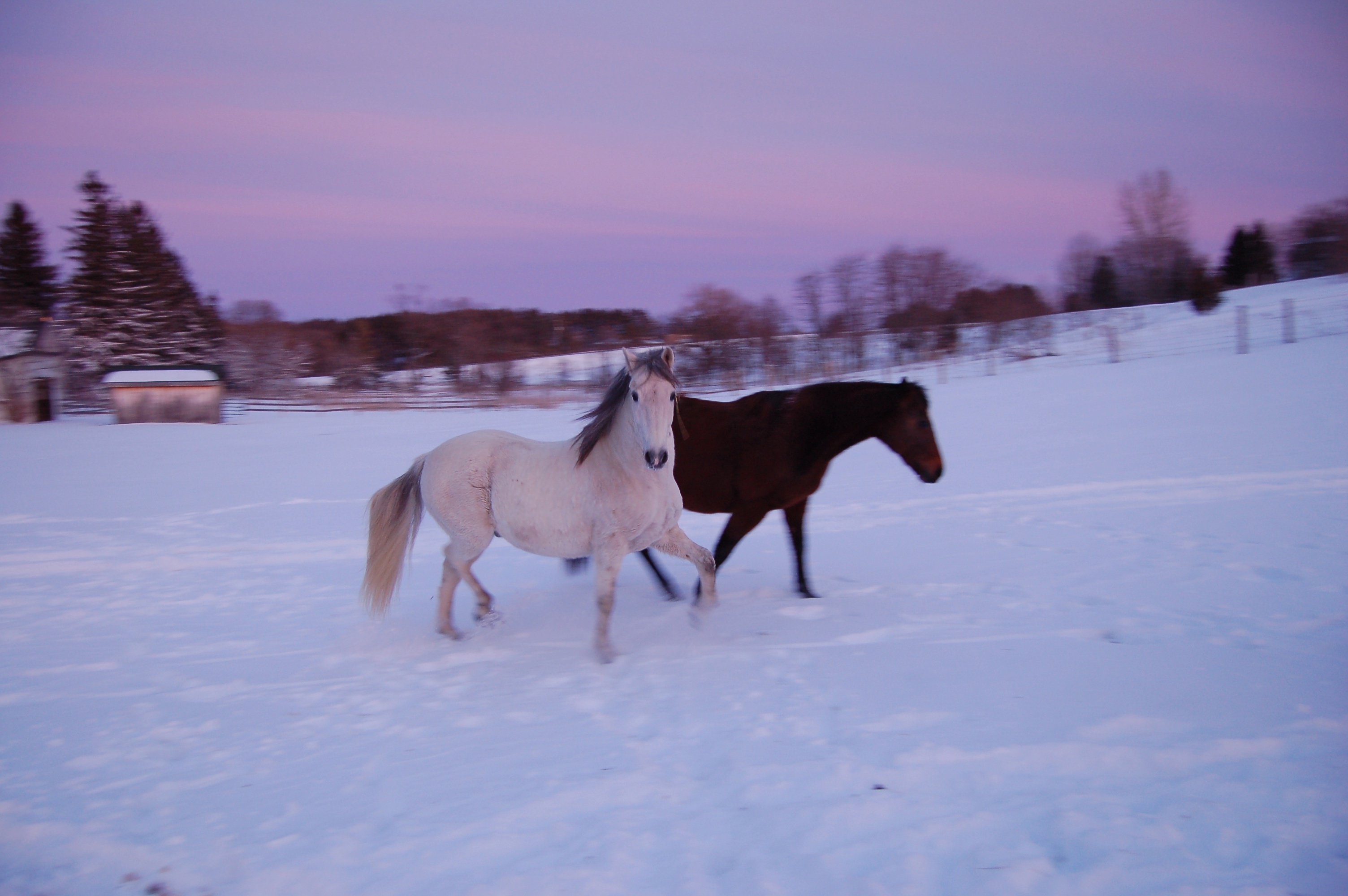 When he came out of the experience and shared with the group he said, “Kathleen when you first introduced the difference between fear (outright physical or emotional threat) and vulnerability (inside change or opportunity), I was not sure I would be able to tell the difference. I had spent so many years reacting to the feeling of fear that I had not allowed myself any opportunities for change.” When asked for one word at the end of the workshop to sum up his experience with the horse, his word was “Courage.” The smile on his face when he faced the challenge of connection and movement with the horse is one that will remain with me for a long time.
Another example of Relationship in Motion (RIM) involved a horse trainer and a reluctant horse. The woman went to get the horse and, after checking in with her body, got the message to go slowly. Later that message would have a lot of significance for her in her personal life. As we watched the exchange between woman and horse we noticed how slowly and deliberately she took each step. Now this woman is a horse trainer so she certainly knows how to get a horse to move. However, she took the time to listen to herself – and what the horse needed – to get to the round pen. I have to admit I had to let go of my idea of what might be happening to support what was happening between them. It took her 40 minutes step by step.
When she got to the round pen I asked her what she wanted to do. Her response was priceless, “I told him the goal was to walk to the round pen and that I would take the time he needed to do this. Once that happened I learned what I needed from the experience.” This horse had a problem with people pushing him beyond his limits. The trainer could feel in her body that the opportunity for him to create a new memory of pressure and release was more important than any goal. As a goal oriented person, this lesson translated to her life and allowed her to feel what it would be like to have forward movement and to maintain connection with herself and loved ones.
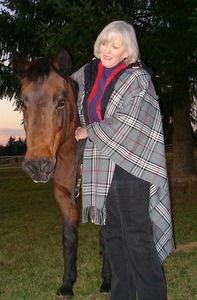 We have had many opportunities to see and observe this connection and movement, or Relationship in Motion, with people and horses. It is the “dance of relationship” with collaboration, full intention and respect that the body remembers when working with horses or people the next time a challenge and opportunity is presented.
I have mentioned just two examples of the work with horses and people from this year. I have traveled over the world this year and seen many more. For this opportunity, I would like to thank the horses and my colleagues; Wendy and Andre at Horse Spirit Connections in Canada (www.HorseSpiritConnections.com); Sun Tui and her herd in England (www.ifeal.me); Eva Balzer and her herd in Germany (www.Zentaura.de); Drea Bowen in Washington state at the Equine Empowerment Center (drea.b.bowen@gmail.com); Lisa Murrell in New York (www.EquineAlchemy.com); Susan Castaneda in New Mexico (www.EquineAlchemy-Southwest.com); and Eve Lee and her horses at Loghaven in Illinois (www.EquineMagic.com).
Many Blessings,
Kathleen
The Change EFL Can Bring to the Horse Co-facilitator – By Beth Goodwin
December 11, 2011 by Kathleen
How the Horse’s Life is Enhanced and Benefited
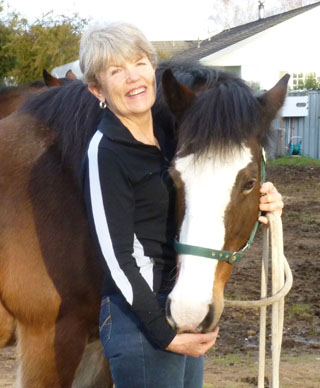
Beth Goodwin
Over the past 12 months as I have begun my journey as an EFL Facilitator I have been amazed at the positive changes I have seen in my own mare and the horses who have co facilitated sessions for my clients who choose to work with their own horses.
One of the first sessions I facilitated was for a woman with several horses. She asked that I work with her and one of her geldings. However, when I turned up to her property it was very evident that another gelding wanted to work with her. While this may be no surprise to many of us in this field, it came as a complete surprise to his owner. She reported that she felt this horse didn’t like her – she had had him since he was a foal, and he always walked away from her in the paddock, especially when she had a halter and a lead rope in her hand. She retired him from his dressage career early as she felt he didn’t like her or the work she was asking him to do. His owner reported, “What I found very surprising was that the horse I least expected to want to participate made it quite clear he wanted to be very much part of this. He was the horse who wanted to help me the most and this stunned me.” He was right there beside his owner wanting a piece of the action. After the session the owner reported how much love she felt had come to her from the horse during her session. What is really amazing to me is this “love story” has continued ever since, even 12 months down the track his owner still reports how he is there at the gate to meet her, and is happy to be caught.
Another interesting case was with a warm blood mare and her owner. Her owner felt she had reached a bit of a plateau with her mare in their dressage work. There were also other things going on between them. When I made contact with the client a few days after the EFL session, she reported a real change in her mare and the previous relationship. She said she didn’t feel like she had to baby the mare anymore (she bred her) and that she had had some “exceptional “rides on this mare. She was really pleased with the change and it was way beyond what she had expected.
A teenage girl asked me to facilitate a session between her and her pony. She wanted to have a better connection with her pony among other things. Her Arab cross pony, while reasonably sensible, could be quite challenging for her. When I made contact with her a couple of days after the session she reported how “We had a lovely beach ride today and he seems very relaxed and settled around me, even when there were some dramas this afternoon”. Then a day later, “He was even more great today after a ride through the forestry; prancing along at a fast walk with his ears forward the entire time!”
The owner of a very upstanding and talented mare asked me to facilitate a session for them both. By now word was getting out that the EFL work was really benefitting the horses and the relationship between the owner and their horse. This horse had been chased by a previous owner, with a flag, into a wire fence. She was very weary of people and finding it hard to trust her present owner. She could not be paddocked with other horses as she hid behind them and was almost impossible to catch. At the beginning of the session this mare looked dissociative. During the session she slowly softened like cheese melting – kept her form but soft around the edges. On following up with the owner a few days later she reported a significant change in the mare. She felt both she and the mare had changed and they had a much more trusting and positive relationship. Several weeks later, the owner reported even more significant changes in her mare. She is now in a paddock with the rest of the herd and very happy to be caught. She can now be floated places as she stays in the float and doesn’t rush out the minute her chest touches the breast bar. The owner reported how she loads her and stands with her and “tells her stories”. She feels the mare listens and then continues to stand there after the story is complete. The owner also has ridden her bare back and jumped her – both for the first time. The owner reported how she had never jumped in her life before but trusted the mare to show her how. She said she was feeling really positive in herself and that she and the mare were helping each other. The day I saw the mare, several weeks after her session, she was happily eating hay with her paddock mates, looking very content with herself with a lovely clear and sparkling eye.
I have also noticed changes in my own mare after she has co facilitated a session with a client. She always seems very proud of herself and she glows with health for days after wards. On one particular occasion her change was really marked. She had worked with a client with cancer. After the session my mare looked like she had just had a body work session – her normally dippy back had come up and she looked like I had just washed and polished her with some show sheen. I took a photo of her and sent it to friends. They found it hard to believe she was the same horse. This change in her lasted for several weeks. I wondered who was actually healing who?
A change like this was also reported by another client who worked with her own 26 year old gelding in an EFL session. A few days after the session she commented how he seemed so much more alert and interested in what was going on around him. Several weeks after the session she said this change had endured.
However by far the most remarkable change in a horse I have co facilitated a session with has been with an 8 year old Hanoverian gelding. He began an early career in dressage with a previous owner and was starting to show intermittent lameness by the age of 5. His present owner was given him as a case study project for her equine sports massage practice. He was progressing nicely. However New Years Eve 2010, he got a fright in the night, and ran into a wire fence. He was found in the morning and by this time he was a mess, with lacerations and cuts all over his body. He was so bad the vet suggested euthanasia. However the owner felt she needed to give the horse a chance. At the time of the EFL session it had been 7 months since his accident. While his body had healed, his mind had not been so fortunate. He had been hyper alert ever since the night of his accident. Even the slightest movement around him and his head would go up rigid and he would take off around his paddock. Anything out of the ordinary upset him. He also found it very hard to be separated from his paddock mate.
He co facilitated two EFL sessions in the one day – one with his owner and one with someone else. In both sessions he found a “happy place”. While he was holding space for the clients to work, it also seemed like they were holding a space for him to work. Several times during the sessions the other horses in paddocks nearby would start running around but this horse just stayed totally focused on the client while in a really relaxed and “zoned” posture. His owner reported that this was really unusual for him since his accident – in fact unheard of. What is even more astounding is that he has maintained this chilled out demeanour ever since the day of his sessions. He is now able to be paddocked on his own, if required, without any fuss. He happily carries on eating while chaos is happening around him. He is really focused on his work and is not distracted by what is going on in his environment. When his owner takes him for a walk in the forest, he is totally focused on her and not wanting to return to his paddock mates as he had done in the past. His owner reports that he is “no longer spooky and lacking in confidence but rather confident and inquisitive”. She can’t get over “how mellow he has become”.
When I started out on my journey with EFL someone asked me who my primary target market was. I replied without thinking about it too much, that it was helping people to have a better relationship with their horses. At the time I wondered where this had come from in the recesses of my mind, but what had me wondering even more was how this was going to be achieved. In my training to that point, I had not seen any really positive effects on the horse co-facilitators. While they had not necessarily been adversely affected there didn’t seem to be any really positive effects either. I could see how if the owners could be more “in their bodies”, congruent and authentic then they would be easier to be around for both other people and horses. I never really expected to see the extraordinary changes clients have experienced both in themselves and in their horses. As one client commented, “equine facilitated learning is an amazing experience and I believe that we are only just scratching the surface of its real potential for humans and horses.”
Beth Godwin
How Horses Help Us To KNOW Ourselves
December 8, 2011 by Kathleen
How Horses Help Us To KNOW Ourselves
Efficacy of EFL supported by the latest brain research by Kathleen Barry Ingram
Co-founder of The Epona Approach
Describing the work with horses as co-facilitators in human development is not an easy task. Simply stated the horses really do help us to know ourselves.
I can’t tell you how often I have witnessed a client coming out of a quiet session with a horse and heard them say: “It was magic! I felt like myself for the first time. My heart just opened and these tears came flowing out—but they felt free, open —you know not jammed up in my throat”. I could go on and on about what people felt in the presence of the horse and what other people witnessed, but I think you get the point. Guess what, it is not magic but is a process scientists now can actually name which happens only in relationship. What the client and others felt, saw, and experienced is the limbic connection of two beings. Relationship does affect the revision of these pathways in the brain through the processes of limbic resonance, limbic regulation and limbic revision or restructuring.
The book, A General Theory of Love is an excellent source for much of the research on this subject. Some of the information contained in this book about how a therapist’s relationship with a client is the determining factor in long term healing; this can be applied to how and why equine facilitated learning works.
[P. 192] “A General Theory of Love
Thomas Lewis, M.D., Fari Amini, M.D., Richard Lannon, M.D.
Because our minds seek one another through limbic resonance, because our physiological rhythms answer to the call of limbic regulation, because we change each others’ brains through limbic revision—what we do inside relationships matters more than any other aspect of human life.
- 1. “The first part of emotional healing is being limbically known [limbic resonance]—–having someone with a keen ear catch your melodic essence…………..a precise seer’s light can still split the night, illuminate treasures long lost, and dissolve many fearsome figures into shadows and dust. (pg. 170) “
Limbic regulation happens through relationship. “But people do not learn emotional modulation as they do geometry or the names of state capitals. These concepts are stored in the neocortical brain. People and animals absorb the skill from living in the presence of an adept external modulator [the horses with congruent and authentic facilitators], and they learn it implicitly.”[1]
Research on how we learn and how much we retain supports what the horses have been teaching us all along. Implicit Knowing which comes from actual experience supports experiential learning, in this case the work with horses. Explicit knowledge, while necessary and important, is not experienced directly but rather through study, education and the experiences of others.
I can’t begin to tell you how passionate I have become about some of the newest brain and body research and information coming from very reliable and dedicated scientists and clinicians. Most of my professional life, I have practiced as a clinician whether I am conducting a session as a psychotherapist, coach, mentor or teacher. The many “miracles” I have been a part of fills me with awe and hope for the ability of people to learn new things, change, and have better lives. The work that I do with the horses has transferred to everything I do and teach since these brilliant beings are so good at helping people come back to their true selves.
The 3 brain theory: Brain in the head; brain in the heart; and brain in the gut supports the work with horses who have a much larger heart field and gut than humans. In fact, too much thinking and remembering can take us out of the moment without enough brain activity for feeling and experiencing. We now know that intelligence is distributed throughout the body. When you have a direct experience it does not go directly to the brain in the head. The first place it goes is to the neurological networks of the intestinal tract (brain in the gut) and the heart (brain in the heart). If we do not feel our values and or goals, we cannot live them. The brain in the heart actually seeks out new experiences and is open to new possibilities which will intuitively matter to you in your life and work. The brain in your gut “reads” what others feel and measures the coherence and congruence of the other’s feeling state and checks it against its own inner state of coherent values, beliefs, and passions. This is why horses, as prey animals, are so good at measuring the inner state of people, checking them out for any incongruence, and responding from their guts and hearts and not from the brain in the head where language can distort and deny what is actually happening.
The book, The Brain That Changes Itself [2] has some of the best information on the neuroplasticity of the brain. Neuroplasticity of the brain is the term used to describe the capacity of our brain for creation of new neural connections and for growing new neurons in response to experience. In the process of experiential learning with the horses, the experience itself, which is very new for most people, i.e., being with a horse without doing anything can actually assist the client in forming and developing new neural connections. I often give a simple explanation like this: The horses help the humans to see, feel, and believe in the possibility that the old super highway way of being and responding to a familiar person, stimulus, thought or action can be replaced by a new path—much like the road less traveled.
In Daniel Siegel’s latest book, Mindsight, he eloquently and factually supports the efficacy of experience in relationship to help people grow and change. He believes that most people come into the world with the brain potential to develop mindsight, but the neural circuits that underlie it need experiences to develop properly[3]. He describes mindsight as our seventh sense and tells a story of a ninety-two year old man who was able to overcome a painful childhood to emerge as what he calls a mindsight maven. Siegel believes, as do I, that it is never to late to stimulate the growth of neural fibers that enable mindsight to flourish. His concept of “feeling felt” is what most people and horses desire to live exciting and meaningful lives.
In equine facilitated learning this sense of feeling felt is necessary whether we are working on the ground or riding the horse. The sense of feel that many individuals describe in natural horsemanship is this implicit way of knowing another being. The explicit learning and knowledge we receive from our teachers and the horses, although very necessary, is not enough to really make the changes our clients and students are seeking.
Equine facilitated learning can and does transform the client’s limbic brain which takes much more repetition than does the “quick fix” of most brief therapies which address only the neocortical brain. The neocortical brain can rapidly change didactic information but without the whole body, the brain in the heart and the gut; only ones’ thoughts and information change. This, in my opinion, is why so many people “understand” why they might do “such and such” differently and still go about life unconsciously without full engagement and lasting results. When all 3 brains are in agreement and the person is living from a conscious place, life becomes a symphony with each day bringing new challenges, joys and sorrows.
The horses and good facilitators both with listening hearts can really help people be open to the possibilities of change and with limbic revision guide them towards the probability of a new life. One of the consistent ways of doing this is what I call holding the sacred space of possibility. This is a space, nestled between two heart beats, where two beings breathing together co-create the possibility for lasting and sustainable change.
Kathleen Barry Ingram, MA
© June 2011
Kathleen continues to teach internationally in training programs in the UK, Canada and the United States.
For more information on Kathleen and her mentorship programs contact her at www.sacredplaceofpossibility.com
[1] “General Theory of Love” Lewis, Amini and Lannon
[2] “The Brain that Changes Itself” Stories of Personal Triumph from the Frontier of Brain Science by Norman Doidge, M.D.
[3] “Mindsight” The New Science of Personal Transformation by Daniel J. Siegel, M.D.
CANCELLED! The Sacred Pause: Living in Uncertain Times: February 14 – 19, 2012, Tubac, AZ
November 29, 2011 by Kathleen
RETREAT CANCELLED
A mid-winter retreat in sunny southern Arizona at Pocket Sanctuary at Kenyon Ranch
Connect with a group of women gathering to seek serenity in the uncertainty of these times and discover new ways to wait patiently in this Sacred Pause. Together we’ll explore the art of surrendering to what “is” by becoming “naked” with nothing to hide, “vulnerable” with nothing to defend, “empty” with nothing to lose, “in the unknown” with nothing to fear, and open to what is meant to happen.
Facilitators are three Elders: Mary Louise Gould, Holotropic Breathwork Practitioner, Kathleen Ingram, Counselor/Coach, and Eve B. Lee, Shamanic Practitioner, who will guide the gathering in activities including meditation, Holotropic Breathwork, shamanic journeying, reflective round pen work with horses, inspired writing, walking the labyrinth and working with dreams.
To prepare for the retreat and to begin to answer the question: “Where do we go from here?,” participants will read When the Heart Waits by Sue Monk Kidd.
Cost: $1850 per person including meals and lodging
Nonrefundable Deposit: $400 by January 16, 2012 (The program requires a minimum of 7 participants)
Save 10% for payment in full ($1665) by January 2, 2012
Save an additional $100 apiece for you and each friend you bring!
For more information contact Mary-Louise Gould at MLGould125@aol.com or 520-975-6126, or log on to www.EquineMagic.com
Horse work will be done at Equine Voices Rescue and Sanctuary: www.EquineVoices.org
Equine Facilitated Therapy, Coaching and Learning Workshop: November 19-20, 2011, Corrales, New Mexico
October 1, 2011 by Kathleen
Experience two days of sharing, learning and collaborating on the next level of Equine Facilitated Therapy, coaching and learning in New Mexico! Join us November 19-20 at Equine Alchemy Southwest in Corrales, New Mexico (just outside of Albuquerque, NM).
Reconnect with the “why” of your work! Featuring Kathleen Ingram and Lisa Murrell, and hosted by Susan Murrell Castañeda, MS, NBCT, this workshop will include community and partnership activities, Group Master Mind Time, and Experiential Equine Time.
November 18: Optional “Meet and Greet” wine and cheese networking event with Kathleen and Lisa: $20
November 19-20: 2 day workshop: $497 (Includes healthy lunch and snacks each day.)
* Payment plans and limited student scholarships available –contact Lisa Murrell for details.
Click here to register for workshop.
Chocolate Turtle Bed & Breakfast
1098 West Meadowlark Lane
Corrales, NM 87048
(505) 898-1800
www.ChocolateTurtleBB.com
Los Poblanos Historic Inn and Organic Farm
4803 Rio Grande Blvd, NW
Albuquerque, NM 87107
(505) 344-9297 or Toll Free at 1-866-344-9297
www.LosPoblanos.com/accommodations
Nora Dixon Place
312 Dixon Road
Corrales, NM 87048-7723
(505) 898-3662
www.NoraDixon.com
Sandhill Crane Bed and Breakfast
389 Camino Hermosa
Corrales, NM 87048
(505) 898-2445 or (800) 375-2445
www.SandhillCraneBandB.com
DATE CHANGE: Coaching Mastery through The Way of the Horse with Kathleen Barry Ingram, Lisa Murrell, and the Equine Alchemy Herd; OCTOBER 12 -14, 2011 Stone Ridge, NY
September 12, 2011 by Kathleen
Due to flooding, downed trees and a general mess with the aftermath of Hurricane Irene my August training, Coaching Mastery Through the Way of the Horse, with Lisa Murrell in New York has been rescheduled for October 12 -14, 2011. Thankfully, Lisa and her horses are safe and well.
Now that Lisa’s place is up and running again, we are excited about presenting the Coaching Mastery workshop as a certified Equine Facilitated Training program for coaches.
For questions about this workshop, please contact Lisa Murrell at: info@equinealchemy.com
To register: www.EquineAlchemy.com
Coaching Mastery through The Way of the Horse with Kathleen Barry Ingram, Lisa Murrell, and the Equine Alchemy Herd; August 30 – September 1, 2011 Stone Ridge, NY
August 18, 2011 by Kathleen
Are you ready to to go ‘Alpha’ in your coaching/EFL practice? Combining horses and coaching is the next level for coaching AND Equine Facilitated Learning. Join Kathleen Ingram, Lisa Murrell, and the Equine Alchemy Herd in New York for 3 days of sharing, learning and collaborating on the next level of coaching and EFL, August 30, 31 and September 1.
Many times coaches feel like there is so much more that their client needs to make a real transformation in their lives; that no matter how powerful their coaching is, no matter how many years of experience they have, they haven’t been able to support their clients to this transformation.
Coaching Mastery through the Way of the Horse is what you have been seeking. Through International Coach Federation Coaching with horses, you can guide your client to the next highest version of themselves.
Cost: $1497 (Includes healthy lunch and snacks each day)
Early Bird Registration by August 19th: $1097
Bring a partner for 10% discount when you register by August 19th!
Visit www.EquineAlchemy.com to register.
Radio Interview from Paradigm Shifters
August 14, 2011 by Kathleen
Listen to the latest interview with Kathleen on Paradigm Shifters:
Audio clip: Adobe Flash Player (version 9 or above) is required to play this audio clip. Download the latest version here. You also need to have JavaScript enabled in your browser.
Believe in the Moment Radio Interview
August 14, 2011 by Kathleen
Listen to the latest interview with Kathleen on Believe in the Moment Radio.
Audio clip: Adobe Flash Player (version 9 or above) is required to play this audio clip. Download the latest version here. You also need to have JavaScript enabled in your browser.
An Informational Day for Mental Health Professionals; Thursday, August 18, 2011; 9:30 am – 3 pm; Silverdale, Washington
July 16, 2011 by Kathleen
How Equine Facilitated Learning Can Support and Enhance Your Client’s Process
Kathleen and Drea will present the latest information on Equine Facilitated Learning; discuss how EFL can support and enhance your practice; and explore the viability of work with horses for depression, anxiety, PTSD and other mental health issues.
Kathleen has just returned from a successful trip to the United Kingdom where she worked with members of the military from the British Combat Stress organization. A 2 day pilot program (through the IFEAL organization) was presented to 4 soldiers who experience PTSD; work with the horses proved beyond expectations the viability of EFL with individuals under the care of mental health professionals.
Cost: $150 (Lunch included)
To pay by credit card (through Pal Pal), contact Drea at:
drea.b.bowen@gmail.com
To pay by check, mail check to:
Drea Bergqusit Bowen
12620 Willamette Meridian
Silverdale, WA 98383
Afternoon experiential sessions optional: Individual sessions from 3 pm – 6 pm available with Drea, Kathleen, and the herd. Contact Drea for limited time slots and costs: drea.b.bowen@gmail.com
About Silverdale and the Ranch:
Drea’s ranch is located just 10 minutes from Silverdale, where you can find hotels on the water, Silverdale Water Front Park, shopping, a brand new YMCA, and great food all within walking distance of your hotel.
Silverdale is located on the beautiful Kitsap Peninsula, surrounded by Puget Sound; the Olympic Mountains to the west and the Cascade Mountains to the east. Summer is an amazing time of year to visit.If you wish to extend your stay there are a tremendous number of things to do in Silverdale. Darkness does not fall until 10:00 PM, leaving plenty of time to play after our day together. Kayaking (Drea has 2 and can round up more if needed), hiking, a ferry ride to Seattle, a visit to the Olympic Peninsula, or a ferry to Victoria, BC are a few suggestions.
Getting to Silverdale:
The Seatac Airport has a shuttle to the Silverdale Hotel and arrangements for a ride can be made if you choose to stay at the ranch.
Accommodation Suggestions:
Silverdale Beach Hotel – located on the water front, offers a restaurant and lounge.
Oxford Suites – boasts a water view and offers a lounge.
Oxford Inn – located one block from the water.
Drea is offering a sleep-in horse trailer with a queen air bed and electricity that could accommodate 1 person. $20 per night. Use the facilities in the house.
Drea has a 27’ Sea Ray that can accommodate 2 people; it will likely be in the water at the marina, a 15 minute drive from the ranch.The marina is magical in the summer, with the Purple Martins are so busy that time of year. The boat has a kitchen and bathroom, the marina offers a deli and showers. $40 per person.
Drea is also offering space in the back yard with easy access to the bottom floor bathroom for those who wish to pitch a tent. $10 a night with the option to coordinate food for breakfast.
CONSCIOUS GENERATIVITY
June 13, 2011 by Kathleen
Recently a good friend, Eve Lee, and I were sitting on her porch overlooking a pond where geese, ducks, and a family of sand hill cranes called home.In the nearby arena her three geldings waited for us to do “our work.”It was a beautiful spring morning with steam rising from the river beyond; an idyllic mid-west morning with a good friend and a great cup of coffee.
Our musings turned towards our life’s work and the impact we both felt we still wanted to make on the world.By previous generations’ standards we “should” be talking about retirement, but retiring from what?Subsequently, I have spent the last couple of weeks playing with words and ideas to describe how I want to live my life and inspire others.
Inpondering, I recalled Erik Erikson’s 8 stages of life concept.Erikson (1902-1994) believed that culture has a massive influence on behavior and that more emphasis should be placed on the external world.His teaching was contrary to the beliefs held by the Freudians of his time.Erikson felt that the course of development is determined by the body (genetic biological programming), the mind (psychological), and the culture (ethos) of the time.Interestingly, Erikson based his premise partly on his studies with the Sioux Indians.
When Googling his name I found that Erikson’s 7th stage – which he describes as “Middle Adulthood” (35 to 65) – is when we can be in the state of Generativity, or self-absorption and stagnation.This stage of generativity applies the basic human strengths of productivity and care. He believed that this stage, where an individual has the option of caring for others and being productive, is a necessary step in development; without this people may fall into a place of self-absorption and stagnation.
The last, or 8th stage (65 to death), he describes as Integrity or despair.The basic strengths of Wisdom can be felt when we can look back on our lives with contentment and know that we have made a contribution. We have gained wisdom and compassion through caring for others; committing to a cause or belief greater than our individual egos, and inspiring future generations. Since most of us do not have personal role models in continuing beyond 65 years of age, I believe that our opportunity is to combine the Generativity of the Middle stage with the Wisdom of the of Late stage,thus my concept of Conscious Generativity.I also realized that, although, the discussion was centered on how Eve and I want to live, teach, and inspire others, this concept of Conscious Gernerativity applies to many of the people I engage with on a daily basis.
For example, in the late 80’s and early 90’s IBM was laying off workers who once thought they would stay with IBM until “full retirement” at age 65.Many of the people were confused, scared and totally unprepared for a new career.An outplacement firm hired me to provide a series of inspirational talks designed to motivate and encourage a revised frame of reference for the former employees’ current situations.One of the talks I gave was called, “There are no more Gold Watches.” Some received the news of early retirement with anger and resentment feeling they had been “done wrong”.However, a few people took this as an opportunity to create and design a new life.Since the IBM lay offs I have counseled, coached, mentored, and taught these people, the ones who are interested in seeking a better way to live and to reach out to others.
 |
| Sunshine |
The field of Equine Facilitated Learning was not even practiced consciously until the early 90’s.We did not even have a name for it then, but trust me the horses were doing the work and just waiting for us to listen (See “Unexpected Grace”) As I describe in “Unexpected Grace,” it was the horses that really taught me how to “hold the Sacred Space of Possibility” for people and for our animal friends.
One would have to be living under a rock today to not be affected by the confusion, fear, and uncertainty generated by the recent economic, political, and environmental events of the last couple of years.Since most of us are still in the process of Generativity (creating, providing and generating), it is more important now than ever for each of us discover our life’s work.When I talk about moving from possibility to probability—it is about living bigger from the heart.So please join me in this concept of Conscious Generativity and challenge others to do the same. As the Hopi elders teach, “We are the Ones We Have Been Waiting for.”
Kathleen Barry Ingram, MA
© June, 2011
IFEAL Graduation UK, June 2011
June 12, 2011 by Kathleen
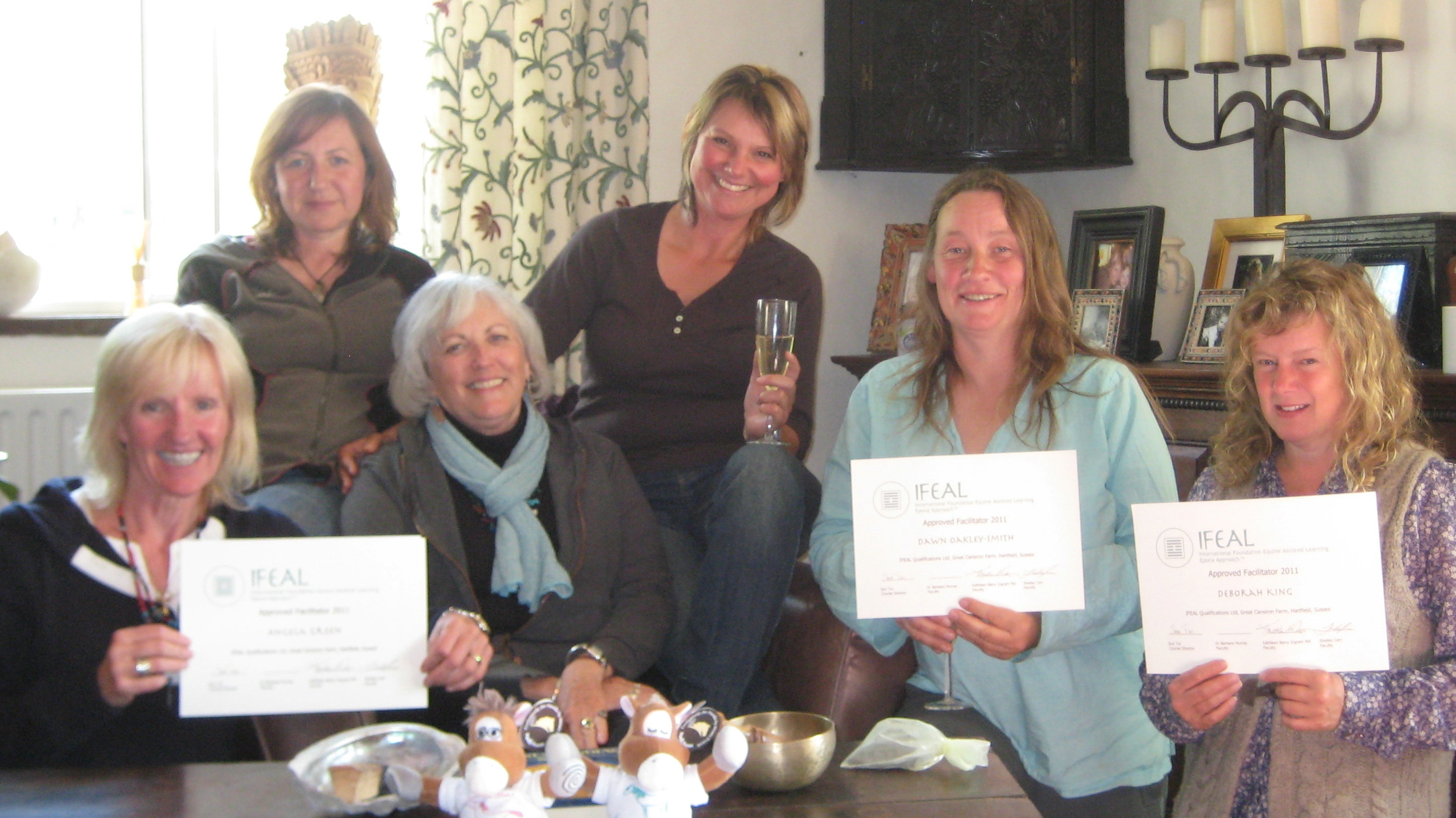
2011 IFEAL Graduates
On June 10, 2011 the IFEAL graduation took place after a full week with facilitators and practice clients. The new facilitators, Dawn Oakley Smith, Angela Green, and Debbie King have successfully completed the program they began last September.

- Barbara Murray
Their integrity, enthusiasm and complete understanding of the work fill me with hope and joy for the continuation of Equine Facilitated Learning in the UK and worldwide. Sun Tui, Barbara Murray and Shelley Carr continue to inspire and teach others through their combined gifts and talents.
2011 IFEAL Herd
Equine Facilitated Learning, Psychotherapy, & Coaching: A Comparison
March 1, 2009 by Kathleen
EQUINE FACILITATED LEARNING, PSYCHOTHERAPY, COACHING: A COMPARISON
The field of Equine Facilitated Learning (EFL) has undergone a lot of changes in the recent years. There has been quite a controversy about how to name what we, who co-facilitate with horses in advanced personal development work, actually call ourselves and how we identify what we are doing. The Epona Approach™ and the work I am currently engaged in with Leigh Shambo at Human Equine Alliances for Learning (HEAL) both agree that the horses are our full partners in this endeavor. Their innate knowledge, wisdom, and accurate intuition guide us as human facilitators when we follow their lead and learn from these consummate teachers. Some practitioners/facilitators identify themselves as practicing Equine Experiential Learning (EEL); Equine Facilitated Experiential Learning (EFEL); Facilitated Equine Experiential Learning (FEEL); Equine Facilitated Psychotherapy (EFP) Equine Therapeutic Learning (ETL); Equine Assisted Coaching (EAC), however I refer to what I practice as Equine Facilitated Learning (EFL). The following information is presented to shed some light on the various ways of working, and on what I feel are some of the most important principles and guidelines to follow as we continue this important partnership with the horse.
Psychotherapy Coaching
• Therapy is about uncovering & More about Discovering
Recovering
• Based on the Medical Model Not about disease but about
of dis-ease and diagnosis optimum health
• Examining the past Being in the present
• Looking to therapist for solutions Mutual examination
for emotional concerns
• Helping clients move from a state Assisting people who are highly
of dysfunction to one of being functional but may not be achieving
functional their full personal or professional
potential
• More of a doctor/patient relationship Partnering with clients in a creative
process
Equine Facilitated Learning and the lessons we acquire from interactions with the horses is based on mutual understanding and respect. As professionals in this field we do need to be aware of the clients’ projections and transference involving ourselves and the horses, and our own counter-transference issues. Much of the information in the coaching profession as well as experiential learning has come from traditional psychotherapeutic principles and dynamics.
The pioneering work of Adler and Jung is noted by Patrick Williams, a psychologist for 28 years who moved into the coaching profession and in 1990 helped in the formation of the International Coaching Federation, (ICF). Williams says: “Adler and Jung saw individuals as the creators and artists of their lives and frequently involved their clients in goal setting, life planning, and inventing their future —- all tenets in today’s coaching.” He also points to Carl Rogers work with client-centered therapy as a “significant precursor to coaching”. (Williams, “Counseling Today” December, 2008)
Edward Colozzi, a career development expert and author of the book Creating Careers with Confidence says; “Although coaching has its limitations, its practice harkens back to the times in many cultures when spiritual leaders, shamans, mentors or others in the community offered informational guidance. It is, in a way, a back-to-the-future paradigm shift. A life coach is a mentor—a person who joins us on a journey. Many people have performed that role in the past. But in a society such as ours that starts to have rules and regulations—that may be where counseling was born. Now, perhaps, we are seeing a return to something more basic.” (Colozzi, “Counseling Today” December,2008)
Irvin Yalom, MD, considered by many as the “Father of Group Therapy”, says that with the current crisis in psychotherapy, there will not be enough trained individuals to do the work. “Psychiatry is on the verge of abandoning the field of psychotherapy. Young psychiatrists are forced to specialize in psychopharmacology because third party payers now reimburse for psychotherapy only if it is delivered by low fee (in other words, minimally) trained practitioners.” Even though Yalom is concerned about the current state of affairs, he is confident that a “cohort of therapists coming from a variety of educational disciplines will continue to pursue rigorous post graduate training.
Equine Facilitated Learning can fill some of what is missing in the health care system . Individuals seeking change from old dysfunctional patterns of behavior and automatic responses based on unconscious motivations can find help and assistance through the Way of The Horse. Yalom says, “At its very core, the flow of therapy should be spontaneous, forever following unanticipated river beds” Therapy following a managed care protocol does not allow for spontaneity and reflection. The horses, as our teachers, and co-facilitators demand that we “go with the flow” and therefore, keep the interaction dynamic and in the present moment.
Short Term Dynamic Psychotherapy, an area I studied extensively in post graduate work with one of my mentors, Dr Paul Rosenberg, works with the unconscious forces (the dynamics) of inner conflict by holding a supportive container for clients to experience in the present moment emotions and memories from the past. Much of the material and teaching I developed for educating students of EFL came from the theories behind this approach and the clinical experience of my clients. What I got to see for myself as I engaged more with the horses was that this dynamic was present in many of the sessions I conducted with a client and a horse. The challenge was how to develop a process in experiential learning that held the container present in a psychotherapeutic session. The container suggested in the phrase I call holding the sacred space of possibility was essential in establishing safety for both the client and the horse. Without suspension of judgment and personal desire for an expected outcome, a reflective round pen and any active or passive engagement with the horse becomes more of repeat of old behaviors and attitudes. “I am the expert and thus you and the horse should do this my way.” The facilitator’s understanding of their own unconscious forces or dynamics underlying their thoughts, feelings, actions and behaviors is absolutely necessary for the client and the horse to have a truly creative and innovative equine experience. The Johari Window, the Karpman Trauma/Drama triangle and the thorough study of projection, transference, introjection and countertransference are ways to enhance and support students participating in an EFL training program. If the student is interested, engaged and encouraged to explore these dynamics themselves, they will be far ahead of many who practice equine facilitated learning, equine experiential learning, psychotherapy and/or coaching.
My own personal opinion around the discussion and controversy of whether to use the designation of equine facilitated learning, equine facilitated psychotherapy or equine assisted coaching when describing your practice is simply this, “Know thyself”. I believe if you know your personal style, understand your thought processes and emotions, and are actively and enthusiastically engaged in a relationship with any sentient being, the likelihood of a mutual and successful partnership is possible. The excellent facilitator is a mentor, a truth seeker, a challenger, and most of all someone who guides each person towards personal accountability, integrity, ease, and fulfillment.
Our teachers, mentors, friends and co-facilitators, the horses say “Thanks for listening”.
Horse Wisdom: photo by Larney Otis
Kathleen Barry Ingram, MA
Excerpt from “Unexpected Grace: How Horses Changed my Life”
Copyright, 2009
Unexpected Grace: How Horses Changed My Life
December 13, 2008 by Kathleen
The working title for a memoir I am writing is, “Unexpected Grace: How Horses Changed My Life” so this is the beginning of the story. I believe it is in those spaces in-between what I call “holding the sacred space of possibility” that grace and guidance happens. I follow what Robert Johnson calls, “the slender threads” in his book, “Balancing Heaven and Earth” and at this stage of my life look back on people, circumstances, and experiences that have guided me, I know the nudges I followed were many times where the most significant changes occurred. As a child and young adult I remember riding horses across fallow corn fields in Indiana with my cousins and feeling the wind in my hair and the pure joy of being in sync with these magnificent beings. When I was older and had children every family vacation included at least one horse ride. My youngest daughter, Meghan, tried many times to covince her Father and me to get her a horse but eventually had to settle for riding her friends’ horses or the horses at my sister’s ranch in Colorado. I loved it all and have to admit I took much of it in stride until grace entered in and changed my life.
My grandmother, Frances Shea Klein, probably wasn’t doing anything extraordinary on the day this picture was taken. This image of my grandmother, placed on my mantel with other family pictures, was one of many in an old photo album I found of hers. Grace is why I believe this particular image was the one I decided to take and reprint for my sisters, children and Aunt. My grandmother, gone many years, was such an important part of my early childhood and I love to think about her in this innocent, beautiful scene with the black and white working horses. What was she thinking about? Her whole life was ahead of her and I imagine she was out on a morning stroll and stopped to commune with the horses and maybe have a long chat. Equine Facilitated Learning is a name for a new field of working with horses in human development but somehow I believe my grandmother already knew this. Barbara Rector came to see me for some consulting and noticed this picture and asked “Are you a horse person, Kathleen?”. Little did I know then where that question and her observation would eventually lead me.
Frances Shea Klein Wisconsin 1908
Cisco at Yvonne Monahan's in Ireland
HEAL’S 2008 GRADUATION CLASS
December 8, 2008 by Kathleen
HEAL Graduation 2008
HEAL and instructors, Leigh Shambo and Kathleen Barry Ingram, are proud to announce the premier class of graduates from the Facilitator Training Program. Jean Ryan Brothman, Ella Bloomfield, Samantha Heath-Lange, and Judith Kay successfully completed the program on October 25, 2008.
Leigh and I wanted to create, design, and implement a program which would encourage talented people to take the HEAL principles, teachings and philosophy to a wider audience of horses and humans. These five individuals, with varied backgrounds and life stories, rigorously undertook the challenge to uncover hidden truths and gifts, thereby discovering their own unique way of presenting and teaching equine facilitated learning.
We learned a lot this year ourselves, and we are confident that these individuals and others can take this paradigm shifting concept to horses and humans. It is time to change and influence how we all relate to each other and we gratefully acknowledge the guidance and wisdom our four legged companions give us on a daily basis.
Here are the graduates in their Own Words:
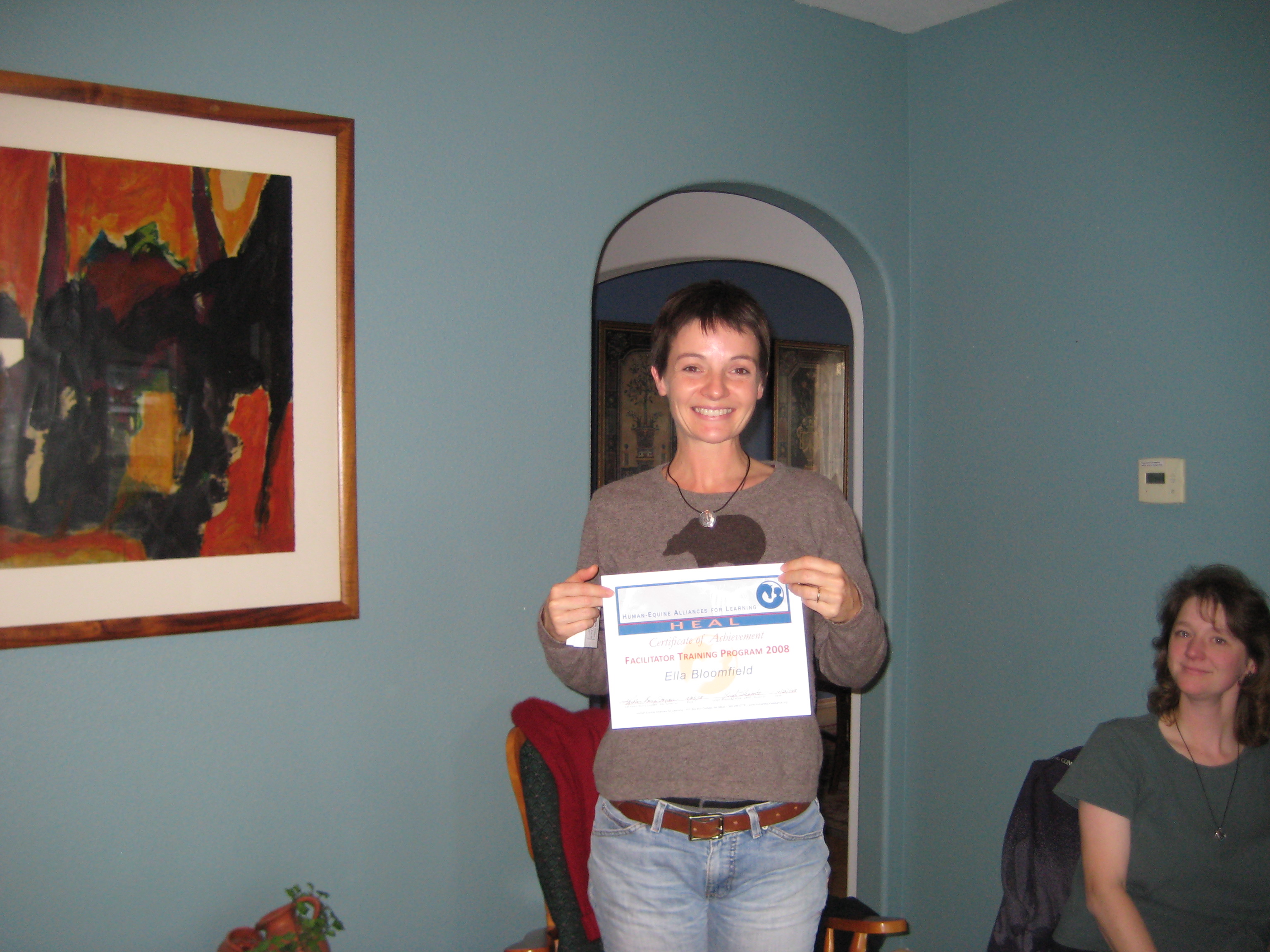
Ella Bloomfield
“Horses have certainly been the healers in my life, but what began as a personal experience and an intuition that people and horses can heal together, has become for me, over the past year, a researched and abiding truth. The HEAL Facilitator Training Program taught me how to celebrate my individual strengths and bring them to a field that heals through the language of the heart. This approach to healing and personal development is a whole-istic experience for all involved – the client, the horse, the facilitator, and the larger circle surrounding each one. This year has been life changing, and I now find myself, all of myself, embarking on a career with horses and people that is both personally meaningful and of great consequence in the world.”
Jean Ryan Brothman from Fort Valley, Virginia:
Jean Brothman & Magic
Judith Kay at Graduation
Sam Lange Graduates
You can contact these facilitators:
Samantha Heath-Lange
12724 128th Ave NE
Lake Stevens, WA 98258
Tel: 360-658-8980
Cell: 206-979-5963
Judith Kay
2732 Ron Court
Colorado Springs, CO 80909
Tel: 719-633-1979
Jean Ryan Brothman
2016 Boliver Rd.
Fort Valley, VA 22652
540 933-6225 Home
540 325-4900 (cell)
Ella Bloomfield
Nash Dom
Hartley Bridge Hill
Horsley
Gloucestershire
England, GL6 0QB
Tel: 01453 835825
Equine Facilitated Learning Opportunities in Tucson
December 8, 2008 by Kathleen
Kathleen invites you to experience EFL for yourself
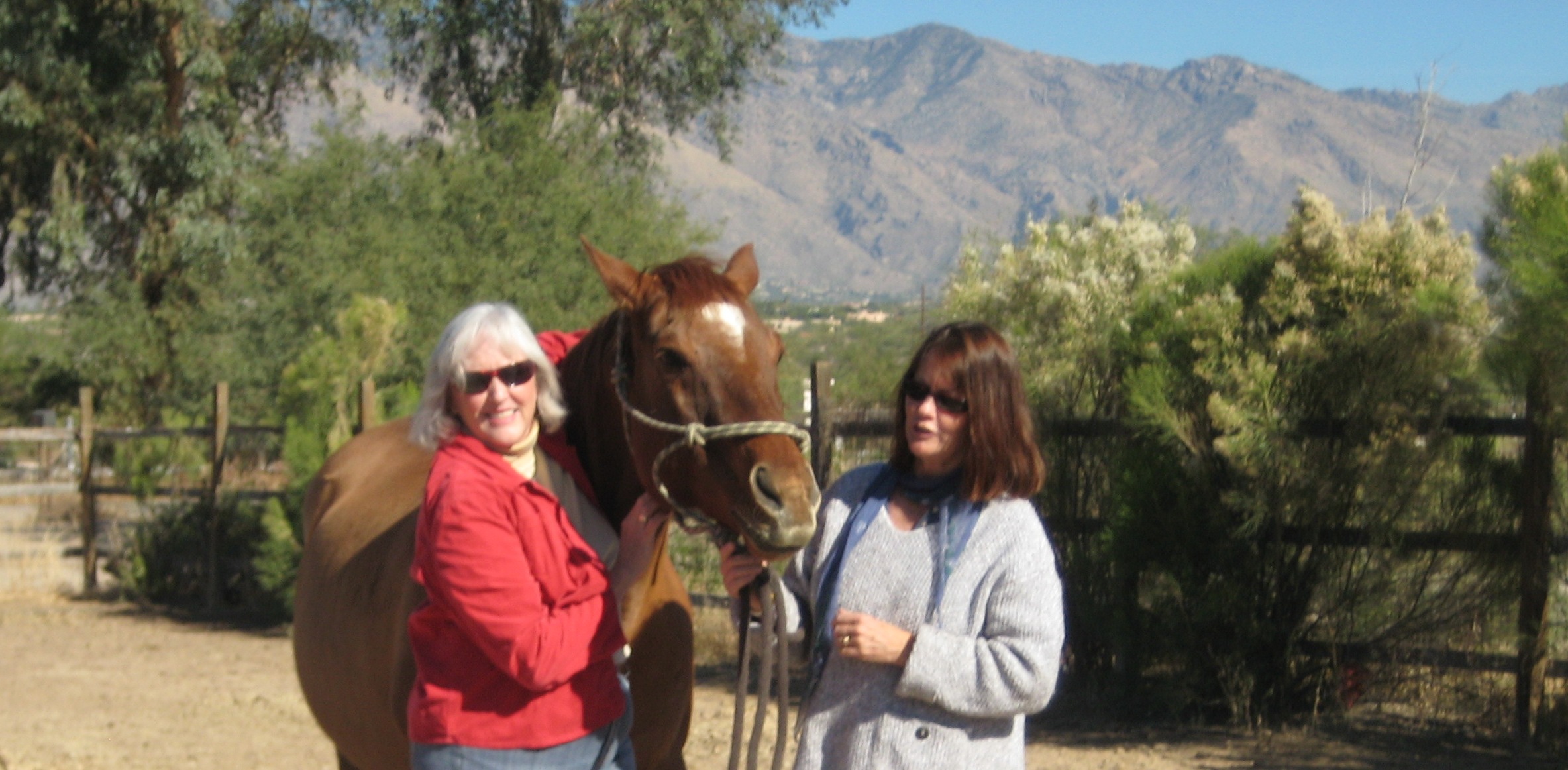
Kathleen, Cutter and Rebecca Paradies
in Tucson. I work at the Ranch on River Road with Rebecca Paradies, www.paintinghorses.net and her horses, Peppy and Cutter. We can work with you individually and also set up other possibilities with families, groups and working teams. Kathleen can arrange for Indiviual and Family intensives for up to 3 days at the Ranch. Contact her for more information and for other venues.
Equine Faciliated Learning: Implicit Knowing versus Explicit Knowledge
November 26, 2008 by Kathleen
EQUINE FACILITATED LEARNING And Implicit Knowing versus Explicit Knowledge
There is, then, both a moral and practical obligation for each of us to look beyond the surface of events…to feel the ground swell underneath the events and perceive the direction they are taking: to perceive the evolutionary trend as it drives social change in our word. “The Choice” by Ervin Laszlo
What does Equine Facilitated Learning have to do with what is called the “Great Turning”? Joanna Macy sees this as “the essential adventure of our time: the shift from the industrial-growth society to a life-sustaining society” which takes into account all of life and nature. Research on how we learn and how much we retain supports what the horses have been teaching us all along. Implicit Knowing which comes from actual experience supports experiential learning, in this case the work with horses. Explicit knowledge, while necessary and important, is not experienced directly but rather through study, education and the experiences of others. If we can take this time to bring forth new dimensions of human intelligence and solidarity among all sentient beings, way beyond anything we now know, then perhaps we can see this as a time of optimism. A time where we can “hold” both the collective nightmare and the collective awakening, the shadow and the light described by James O’Dea, president of the Institute of Noetic Sciences. Peter Russell calls this time a place of integrated “trans-egoic” consciousness.
My experience with horses has demonstrated, without question, these adept facilitators can teach us more about us as sentient beings and also how to traverse the obstacles and challenges we are facing as a species today. Christopher Bache, in “Dark Night, Early Dawn” calls this the “dark night of the species-soul”. Maybe it is time for other species, in this case the horses, to teach us how to live and respect all of nature.
The 3 brain theory: Brain in the head; brain in the heart; and brain in the gut supports the work with horses who have a much larger heart field and gut than humans. In fact, too much thinking and remembering can take us out of the moment without enough brain activity for feeling and experiencing. We now know that intelligence is distributed throughout the body. When you have a direct experience it does not go directly to the brain in the head. The first place it goes is to the neurological networks of the intestinal tract (brain in the gut) and the heart (brain in the heart). If we do not feel our values and or goals, we cannot live them. The brain in the heart actually seeks out new experiences and is open to new possibilities which will intuitively matter to you in your life and work. The brain in your heart “reads” what others feel and measures the coherence and congruence of the other’s feeling state and checks it against its own inner state of coherent values, beliefs, and passions. This is why horses, as prey animals, are so good at measuring the inner state of people, checking them out for any incongruence’s, and responding from their guts and hearts and not from the brain in the head where language can distort and deny what is actually happening.
Many of the people talking about the changes inherent in the shift refer to the heart as the change agent essential to this new paradigm. The Institute of Heartmath, a research organization, has measured the heart’s electromagnetic field which is 60 times greater in amplitude than the electrical activity generated by the brain. Some of their research has involved horses because of their large hearts. Love is at the heart of evolution and the healing source. Spiritual resonance is an energetic resonance coming from the heart and the limbic brain which connects with others in a “unified field” so that when one person sheds the layers of illusion it encourages others to find their true voice and authentic self. It has been found that clarified states of consciousness have a contagious quality. A psychiatrist, Elio Fratterolli, coined the term “affect contagion” where emotions both positive and negative can be “caught” by another person or persons.
Research on the brain in the head and how events, emotions and learning are stored in neural pathways (starting with the brain in the heart and gut) supports the efficacy of Equine Facilitated Learning. The triune brain (in the head) consists of three distinct sub-brains that have separate functions, properties and chemistries. All three of these brains developed in evolutionary history in separate ages. The reptilian brain handles basic bodily functions such as: breathing, heartbeat and swallowing and some animals, snakes for instance, operate singularly from this part of the brain. The limbic brain, the one we will discuss in this essay in length, functions in all mammals to assist them in birthing and caring for their young. The limbic area of the brain is where our ability to relate is felt and stored. The last, but not the most advanced, part of the brain in the neocortical brain which functions in humans and to a lesser extent in mammals to assist in reasoning, writing, language and planning.
The book, “A General Theory of Love” is an excellent source for much of the research on this subject. Some of the information contained in this book about how a therapist’s relationship with a client is the determining factor in long term healing can be applied to how and why equine facilitated learning works. Relationship does affect the revision of these pathways through the processes of limbic resonance, limbic regulation and limbic restructuring.
Look at some of the direct quotes from this book about limbic revision and see if you agree. “The first part of emotional healing is being limbically known [limbic resonance]—–having someone with a keen ear catch your melodic essence…………..a precise seer’s light can still split the night, illuminate treasures long lost, and dissolve many fearsome figures into shadows and dust. (pg. 170)
Limbic regulation happens through relationship. “But people do not learn emotional modulation as they do geometry or the names of state capitals. These concepts are stored in the neocortical brain. People and animals absorb the skill from living in the presence of an adept external modulator [the horses with congruent and authentic facilitators], and they learn it implicitly.”(pg. 171)
Can you see how Equine Facilitated Learning changes an individual’s implicit knowing rather than teaching or explaining a feeling or event through explicit knowledge and why this is more valuable for a lasting and long term change to occur?
“These novel pathways have the initial fragility of spring grass, but they take deep root within an environment that provides simple sustaining limbic nutrients. With enough repetition, the fledging circuits consolidate into novel Attractors. When that happens, identity has changed. The patient (person) is no longer the person he was.” (pg. 179)
Through this work with horses’ new neural pathways in the brain will develop which will eventually become a superhighway replacing the other highway which helped the person to survive but keeps them from thriving. The third stop for nerve impulses, after going to the other two brains (heart and gut), goes to the area of the brain in the head known as the medulla located in the limbic or feeling brain. The medulla is a vital link with the RAS, reticular activating system, which has evolved over millennia with an inherent tendency to magnify negative incoming messages, like fear, and minimize positive ones. Information coming through the RAS goes quickly up to the neocortical brain and assists in making the decision to fight, flee or freeze. This was needed in the Stone Age to protect us from danger which helped us to survive as a species. However, to thrive we need to be able to differentiate between actual outside fear and vulnerability. Vulnerability is an” inside feeling” which feels the same as fear, but has a very different message usually having to do with change or a challenge. Sometimes it is the more positive feelings which seem the most threatening. This work can offer an individual a “corrective emotional experience” when the stimulus (the feeling) is familiar but the response and outcome is different. It does take some time for a new neural pathway to develop; however, the good news is that adult human brains have enough plasticity to do this.
The neocortical brain collects facts: new facts and new paradigms can change existing facts quickly. The limbic brain does not change quickly; however, continued exposure to another mammal (us or the horse) can restructure the limbic brain of another person. I see this as evidence as to why “talk therapy”, self-help books, and traditional cognitive/behavioral techniques can only affect the part of the brain that reasons, plots, speaks, writes, plans and records. The neocortical brain is not the most advanced of the three brains but only the most recent. Again from a “General Theory of Love, “Evolution is a kaleidoscope, not a pyramid: the shapes and variety of species are constantly shifting, but there is no basis for assigning supremacy, no pinnacle toward which the system is moving……We are free to label ourselves the end product of evolution not because it is so, but because we exist now.” (pg. 31) They suggest that we expunge our temperocentrist bias. Our work with the horses demonstrates this. Our teachers are these magnificent mammals who have a much larger limbic systems and smaller neocortical brains.
Here is one of the best descriptions I have seen of what I call”holding the sacred space of possibility”: that space in-between words and doing where a container of support to be is created that is fully engaged, not tied to the story, and is open to “what is happening in the moment”. Horses and other animals do this naturally. “The therapist who cannot engage in this open adventure of exploration will fail to grasp the other’s essence. His every preconception about how a person should feel risks misleading him as to how a person does feel. When he stops sensing with his limbic brain, a therapist is fatally apt to substitute inference for resonance. Therapists prone to surrender limbic vision come from schools that offer cookie-cutter solutions.” (pg. 183, A General Theory of Love)
In conclusion, equine facilitated learning can and does transform the client’s limbic brain which takes much more repetition than does the “quick fix” of most brief therapies which address only the neocortical brain. The neocortical brain can rapidly change didactic information but without the whole body, the brain in the heart and the gut; only ones’ thoughts and information change. This, in my opinion, is why so many people “understand” why they might do “such and such” differently and still go about life unconsciously without full engagement and lasting results. When all 3 brains are in agreement and the person is living from a conscious place, life becomes a symphony with each day bringing new challenges, joys and sorrows. All of nature and the animals are calling us, reaching out to us, and saying: We are and have always been ready to teach, support and guide you with our innate wisdom.
Excerpt from “Unexpected Grace”
Copyright, 2008
Kathleen Barry Ingram
Resources:
Institute of Heartmath www.heartmath.com
Institute of Noetic Sciences www.noetic.org
“Healing the Soul in the Age of the Brain” Elio Frattarolli M.D.
“Dark Night, Early Dawn” Christopher M. Bache
“The Mystery of 2012” Sounds True, Inc.
“A General Theory of Love” Thomas Lewis, M.D., Fari Amini, M.D., and Richard Lannon, M.D.
“The Other 90%” Robert K. Cooper
“Quantum Shift in the Global Brain” Ervin Laszlo
“The Global Brain, Waking in Time” Peter Russell
“The Great Turning as Compass and Lens” Joanna Macy (The Mystery of 2012)